Welcome.
This site consists of 1.Theory, 2.Pictures, 3.Literature, 4.Audio and 5.Crafts.
Pages 3. 4. and, to an extent, 5. betray a latent intent to enact a renaissance gesamtkunstswerk that includes pictures, poetry and music. Presently, these latter three pages include only exemplary placeholders, while page 5. includes a partial provenance.
The site explores the meaning of fiction as distinct from its popular deceptions, and so embodies a High Concept outlook that asserts the metaphysical identity of fictional Artistry in any modality and further asserts that Art’s identity is an identification of the perceiver’s Self through the relevant artifices of light, sound and literary performances, which magical idealism betokens an intent as old as mankind. The medium of any fiction is matter, but its answer is kindled in the abstract mind of any conscious attendant.
The art-work is a magnetoid kernel of its maker’s persona, a cultural pearl, often outliving its maker as did Achilles’ Trojan fame in Homeric legend, which saga’s origin was firstly the echo of an oral recitation, meaning the faction of memory and its editions which would constitute an abstract art even earlier than any literature that depicts imaginary events; books were once the mere mute reportage of events from such oral records, outspoken, to inform illiterate milieus.
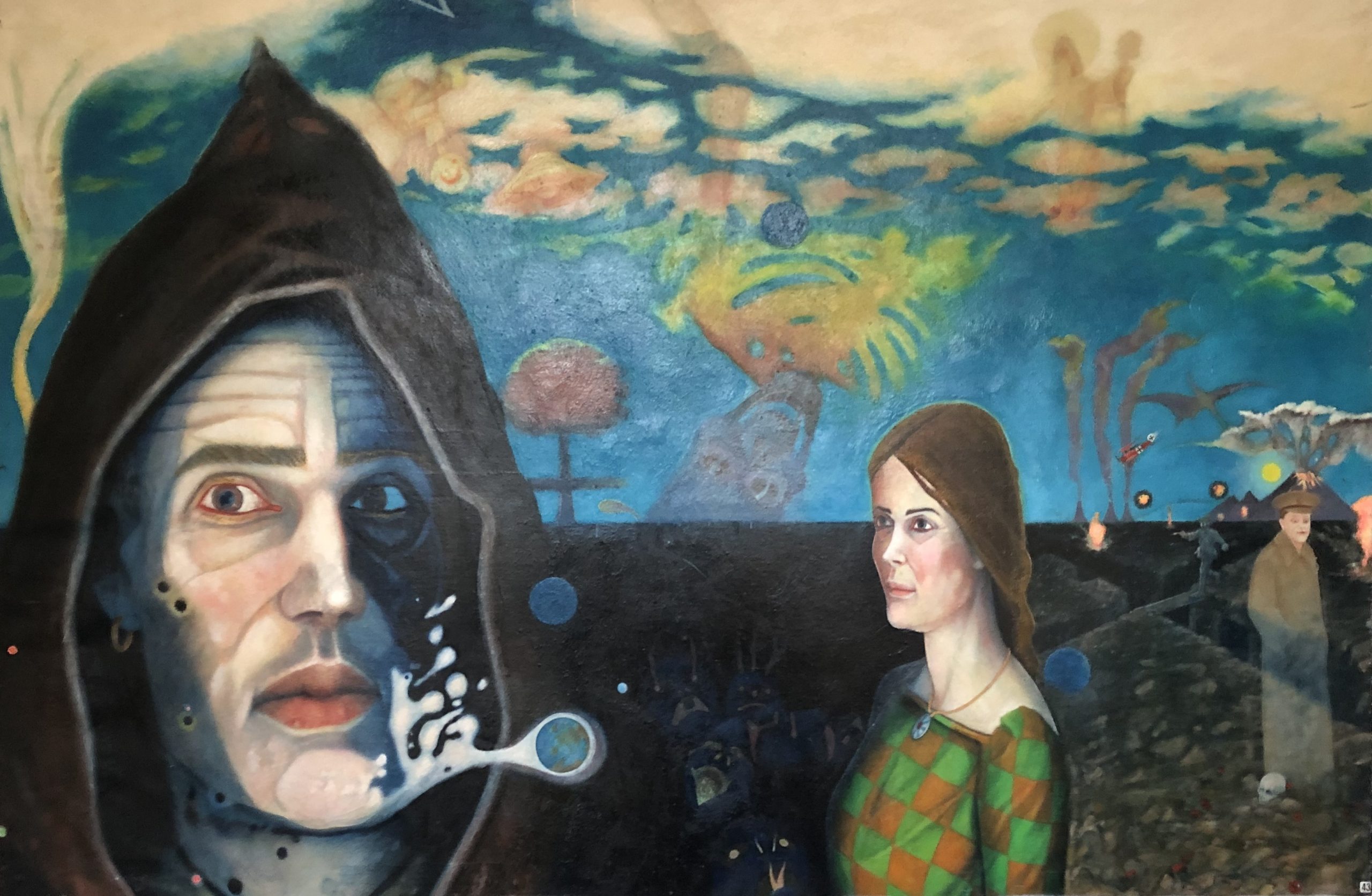
 Psychoscopia is a coinage from the Greek meaning Soulsight or the perception of the perceiver within real physical space, of the perceivable static picture, in so far as that image also depicts, as if a recursive entity, an imaginary space beyong its pictorial surface, much as if that surface were a window and not an obtructive plane that blocks the space of the world outside beyond the real room, as a hunter’s camouflage might block a wanderer’s recognition. As an existentialist youngster, I would deliberately study extreme viewpoints, whether of frog or bird. ( 2.THORNHAM ST.)
Fiction is recursive and looks back at the cultural consumerist while even the fanciest brickwork is not an image but only an indifferent functional fact like the monocular eye of the mindless speed camera. Pattern is the middleground between function and fiction, which is all memory is.
Craftsmen make letterboxes but those are the practical works of artisans and not representational objects like the images of the muses; one does not merely perceive credible chairs, one sits on them and hopes they are soundly ‘painted’ and not badly built booby traps, even if carven by a Grinling.
Objects do not refer to anyone, save as slaves, but art objects do refer to a subject, because they are ideal, not merely real. Everyone, to some extent is a pseudoaesthete, as if fictional Artifices measure the soulfulness of any given observant soul. Fiction is phenomenoid mimesis, but it is also always factional, given the public confession of a pseudobiography is virtually inescapable.
Pictorial art is figurative, though Art can be demi-abstract as in Turner or it can be photorealist, the realism of whose work vies redundantly with photography; photography, however, is no truthfuller than organic fiction, because its juxtapositional choices betoken journalist agendas.
The theories of spatial literalism that underpin Western art were known to Leon Battista Alberti and others during the Italian renaissance. Such real spatialism was a new concept in art through the exploration of perspective that was partially inspired by scientfic researches of the kind Da Vinci undertook.
Accurate perspective in a picture must, perforce, reflect the onlooker of the painterly object, an object that seems to be an organic mirror on a plane of oil-bound ground dust, earthy pigments, arranged on thin cloth, as if on an opaque window whose skin mimics space beyond, like a mirage or daydream.
Visual art is thus a reflexive phenomenon comparable to the making of organic tromp l’oeils or comparable to the making of reflective mirrors, which things all visible objects are, that is, three-dimensional mirrors when lit by any light source that generally (and thankfully) disguises the space inside said body/ies.
Fiction is an artificial mirror of the natural mirror of perceivable Nature while literature describes (rather than prescribes, like philosophy), being a mirror of living behaviour. Our daily lives are sunlit, which might mean our nightly dreams, like art, are either moonlit or starlit nightscapes.
Even so, one depicts outer space by depicting its reflective objects, while depiction, per se, is de facto idealist, since only the subtance of the media is real, while the image it hosts is a mimesis of spatial reflections. The 4th wall is you, which is why the world always refers to its tenants, and not to itself. Were the Earth a global eye, its reflective seas would be a changeling eye upon which lens images of its sun-stricken clouds would show like images on vast, disparate, revolutionary retinae.
Any figurative image when seen from the correct distance, as Alberti writes, recursively depicts the percipient subject so, to quote a friend, the picture looks back at you, especially if it is hung at the roughly average eye level height which pictures in galleries often are not, given they are hung like standee slaves on plush podia for rich hoarders, window shoppers, or for culture vultures to ogle when not for other artists to ape, envy or overlook. Fiction is the remote presence of its conscious maker and to that extent pertains to a hex or hoax which is aware of its consumerist.
In the mid-eighties a friend introduced me to the work of Bruno.
The inspiration for Psychoscopia came partly from my youthful interest in same, but was informed in the late 1990’s by my hire as a portrait sculptor and hobby miniaturist, through which experience I realised that the miniatures I made were natural images of the scales of perspective, which coincidentally betoken the perspective of Infinity, as suggests.
Although the senses are a finite shell, their inverse perspective betokens the infinity within, from which reality may be projected, awarely or unawarely.
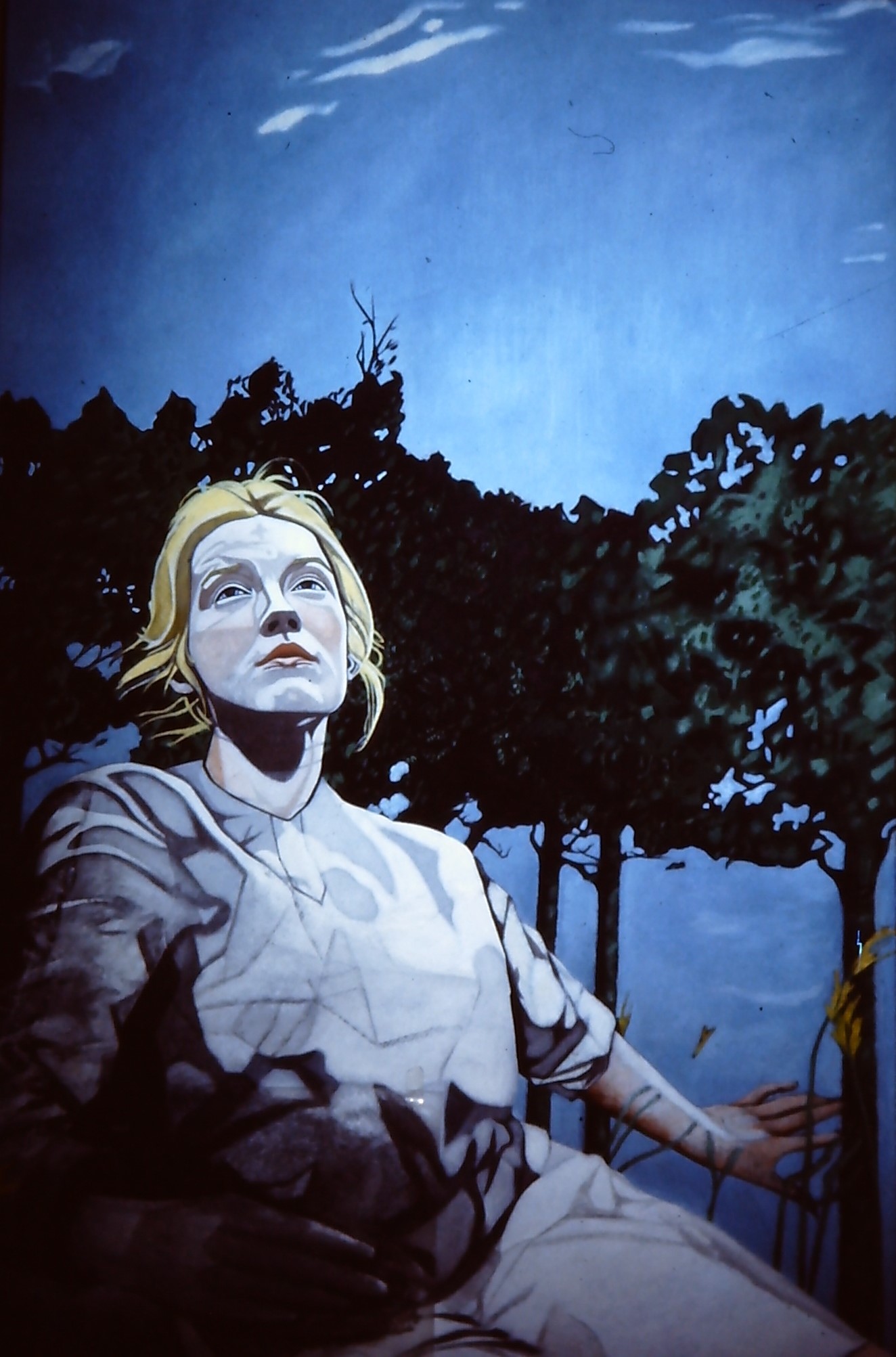
I made a transparent scale perspex template in the proportion of 60″x40″ to help the accurate invention of figurative picture and to try a photoportrait of a friend’s daughter . I noted that when handheld, the distances of real world figures on its surface in real space allowed me to correlate figurine scales to real world distances.
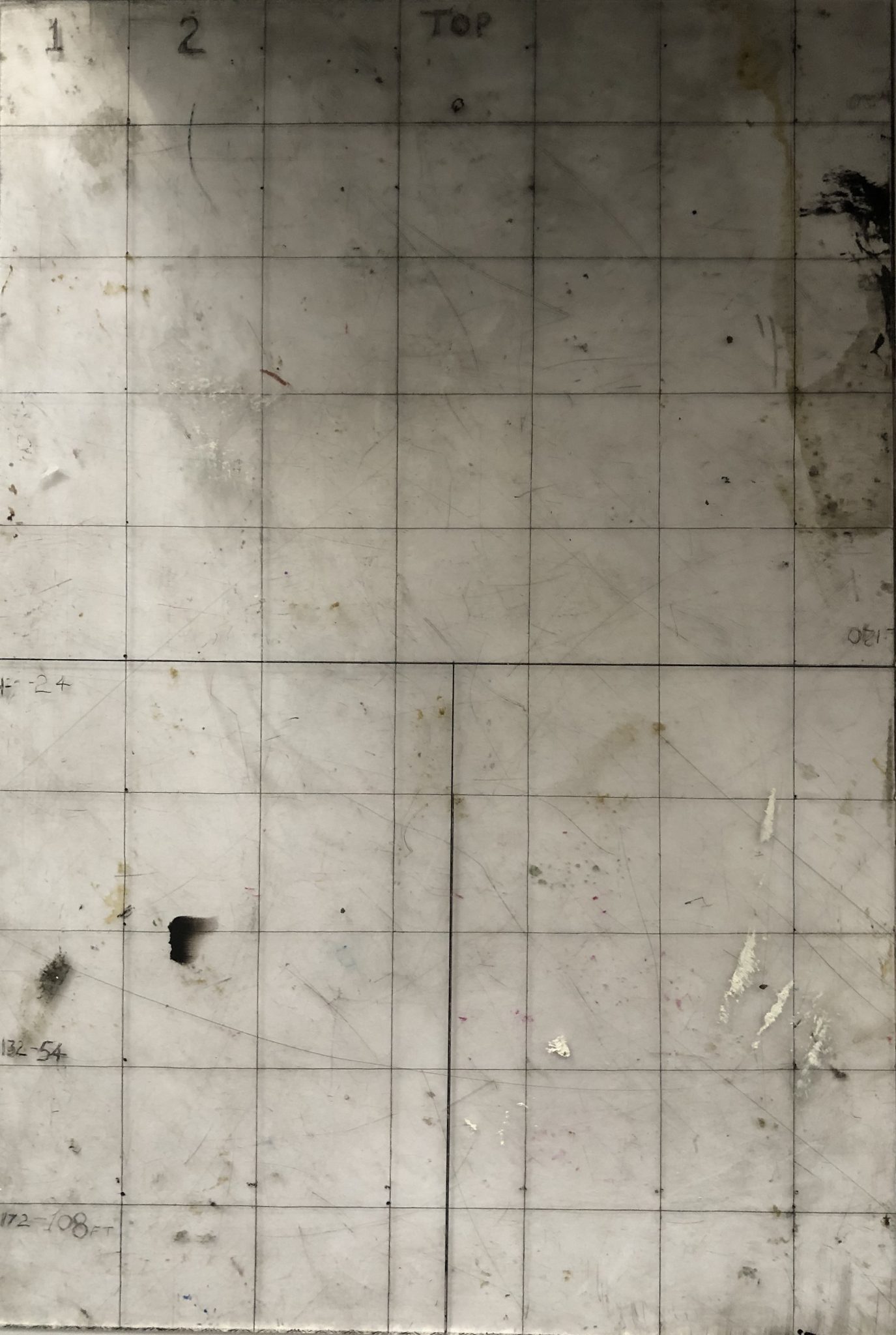
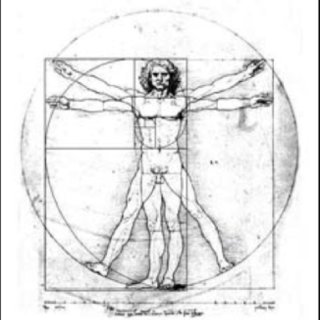
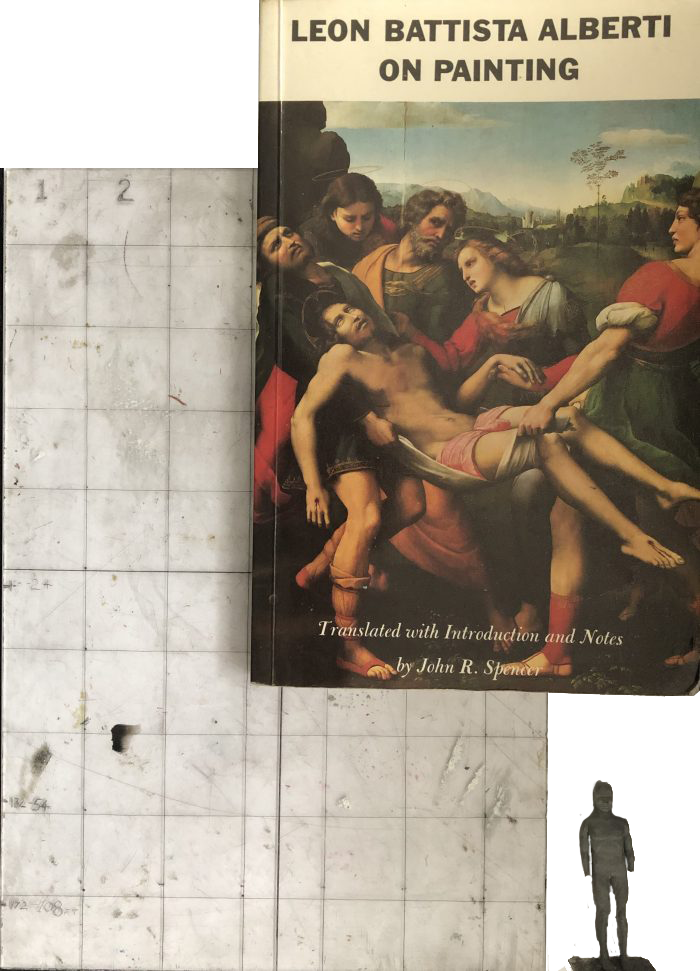
Thus, by miniaturist kitsch coincidence I was led to Alberti’s treatise, On painting, long before I read it, whose theories placed the onlooker in real space (and at eye level).
Famous artists used models for complex big pictures like David’s coronation of Napoleon. One places oneself in the correct real space by knowing that say, a background figure of 20 mm on the picture plane, is 108 feet away in real outer space.
The horizon is roughly five miles away from the eye-level grounded point of sight. The picture, as an imitation of lit space, is a fiction, but not a lie, as camouflage is, of absence; rather, is a likeness of presence, an eidolon like a public image of mental images, one redolent of memory, confessional yet ingenuous – the pearl of fantasy gathers slowly around a kernel of stubborn memory as if the picture were the crafty ghost of a daydream, publically materialised by the awoken crafter.
A picture is a painterly film of fantasy on a 2-dimensional surface that becomes an invisible blindfold or pseudotelescope, an imaginary space that is a screen between the real static seer and the static objects in the imaginary space inside the picture’s editional frame, as if the image were a spectral kaleidoscope shaken by one’s own outlook as that settles the image against one’s average judgemental taste, that compares said content with the consumer’s normal choice of the beauteous.
One looks inside a picture as if through a big ideal keyhole, since one already views the image from within a big and real room.
The mind is a dark room into which skillful pictures cast and breed their likenesses into a local witnesses memory, and do so not from the environment, but from the private dreams of another imaginative brain into the public property of your own luciferious mind that reflects the work. Naturally, the locale and interior of any art gallery, colours one’s outlook.
The surface of any picture is as virtually invisible as the the organic pupils through which one sees it. Any picture can behave like a warp in space (as Riley’s work or as Op art literally did). The honest lie, which is any fiction in whatever perceptual mode, is an implant in social reality, and like all true art, must be seen in perspective, figuratively and socially.
BRUNO and HERMETICISM.
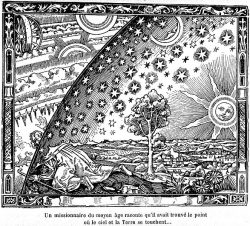 Imagination is creative, fantasy is parasitic. Inistence lacks spatial presence. Perspective percept. Subjectivity is in one’s spatial presence. Scalar infinity of an imperceivable but conceivable sum.
The globular shell of perceptual perpective inverts in the percipient, to spiritual infinity, where the craft of art amounts to secular spirituality as if fiction were only a democratoid tool and not the ambitious maker’s narcissist careerism. The hologram is the beam-fed mind which analogues it.
Hypnogogoid doorway. No outside. Fictional zero. Holes in the sum. Perspective is the proof of existential presence. Imagination is creative, fantasy, parasitic. Inistence lacks spatial presence. White light. Perspective percept. Perspective of perception, instinct of conception. Image of space, image of Time.
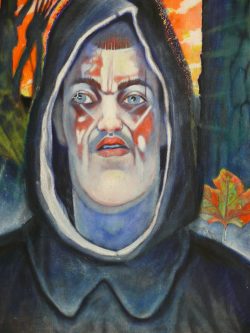 The relevance to Bruno in my work is the element of existentialism that the placement of the self, (often fossil in its habitual conscience) by way of the pictures recursive perspective that therefore matches the real world position of the Seer also, as a consicous being, and not merely as a voyeur: Alberti realises Bruno’s conscious perceiver, the deist Hermit or immortal Hermes.
Such an existentialist hex can betoken the status of the magus who enters other dimensions of space-time through the subconscious hynagogoid doors of an organic museum of twilight imagery which visual art can also inspire – think of Holbein’s famous anamorph, of Spare, Roerich, Parrish, Swann, Burra, Wonnacott, even of the exceptional Riley and of what is called Magic Realism.
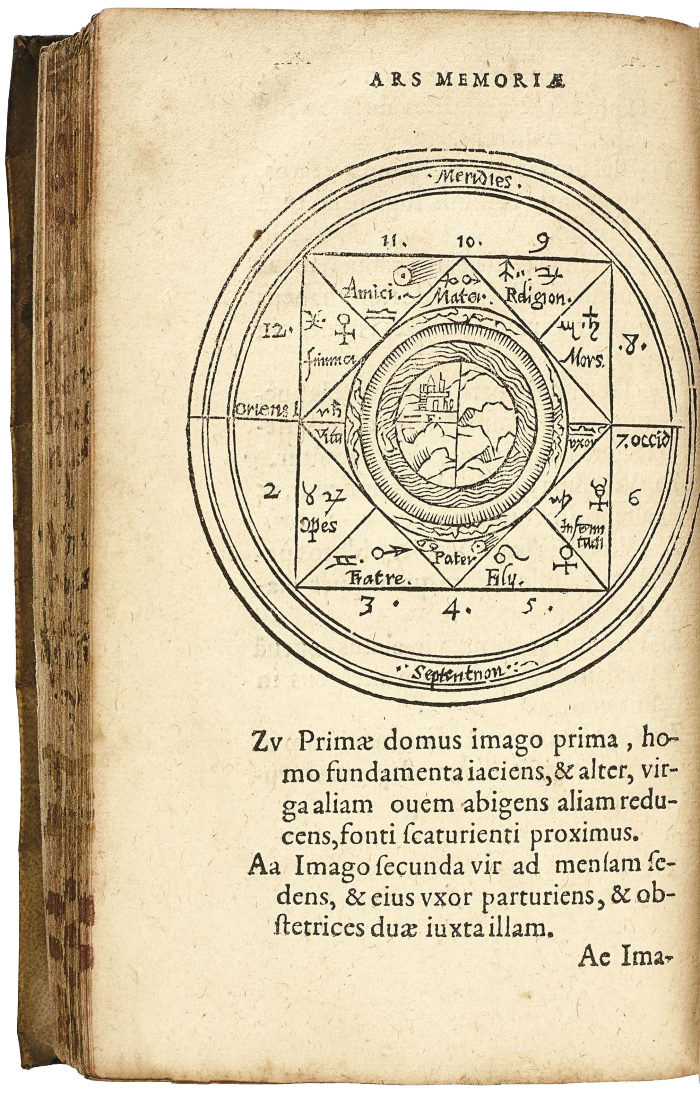
WAGNER and DIE GESAMTKUNSTWERK or PANMIMESIS.
Poetry is a literary/oral diagram of philosophy, whose lyrics can match emotional music. Hearing perceives phenomena, but listening conceives imaginatively. An image of space, an image of Time, an image of emotion, betoken painture, literature and music, while we assert, incidentally, that literature is the true abstract art as it is the least accidental of skills. Panmimesis mean all Muses.
In painting, the artist is conceivable but seldom perceivable, unlike the dancer, actor or musician and this is truest of all for the writer, whose fiction is as abstract as language itself, and no more random than mathematics; however, the Fictionalist or Ficteur is always a factional provocateur in that his or her choice of themes are always particular or partisan, thus as honest as an animal’s taste.