2x Oils on perspex.
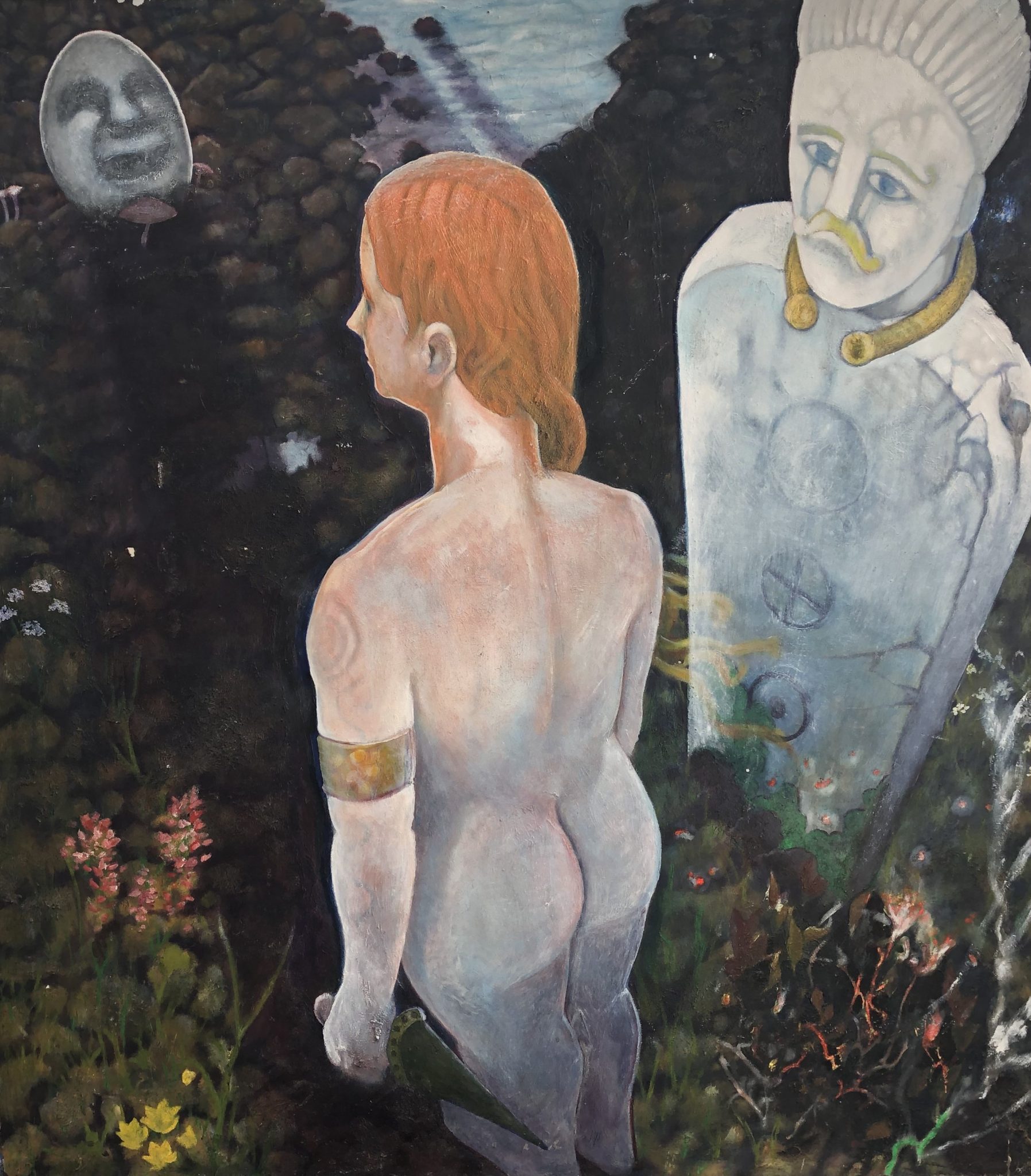
The young Boudica.33x37. (81)
One of two experiments on perspex, a bird's eye view of the comely young Boudica at her sun worship ritual in her maidenly youth before her notorious queendom. The idol is a familiar trope, a crude tribal mime of classical continental urban sculpture.
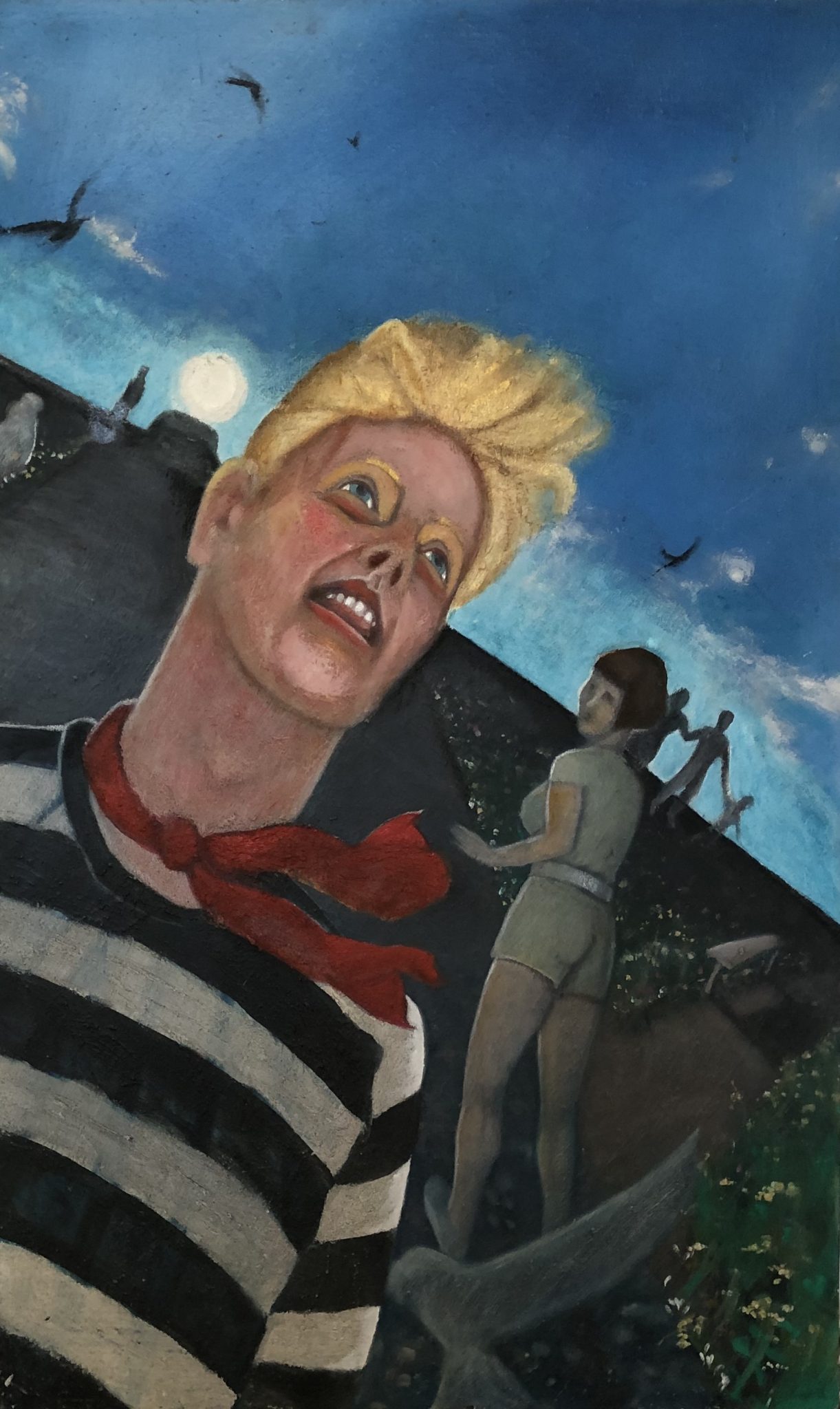
Alfriston.16x25. (82)
Another self-portrait on perspex that happily turned into a semi-portrait of my younger brother, a kind of nostalgic memo picture with another accidental abstract semi-portrait in it, of a Baltic friend.The shirt is like one worn by a Scottish singer hero of mine who wore it like a trademark uniform, but it is also like some ancient cliche of a Frenchman or a comic burglar's shirt. The angle is Dutch, as the pictures are sometimes meant as literal optical illusions, embellished with real gold and with light in luminous paint form, and made to exist in real aesthetoid and literal space.
11x Sundry oils on canvas.
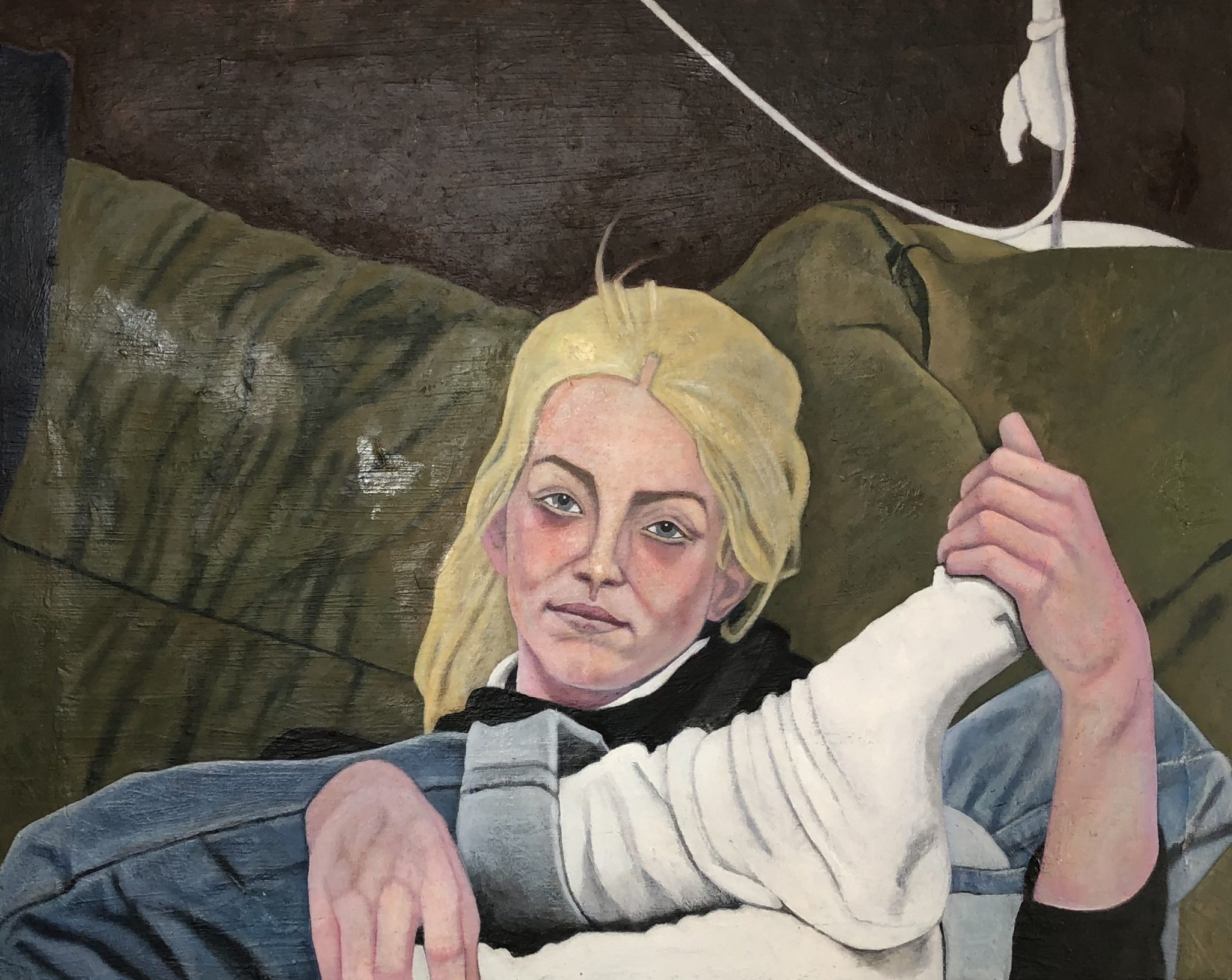
Julia Melinda indoors. 24X30. (40)
Photo Portrait from a photograph by a friend of her daughter, originally a monochrome painting.
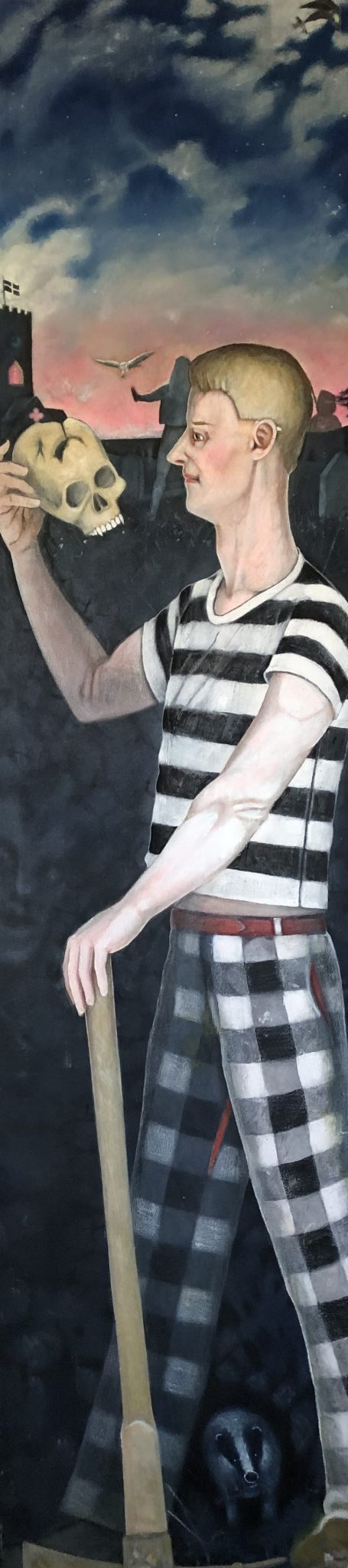
The Archaeologist. 22X90. (95)
Originally a self-portrait but became a semi-portrait of my brother unearthing an infamous criminal's head in a boneyard, the stuff of folklore legend. Luminous paints were used for the sky as on other pictures in an effort to achieve luminary literalism.The nominal location is Cornwall. A faint monk walks from the right and a pareidolia of a monk on the left besets the skull's superficies, as if a shadow of zero, walking downwards from the church.
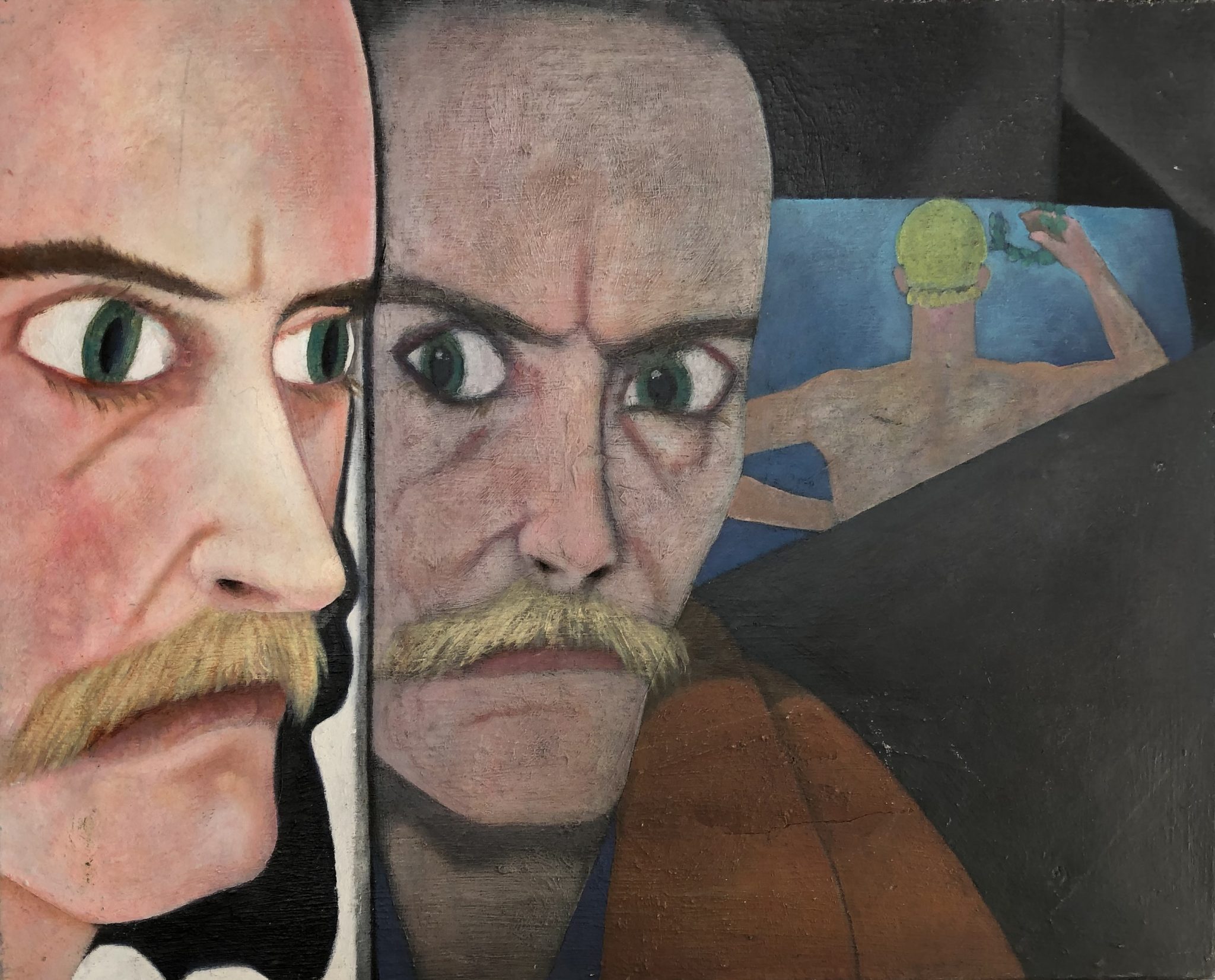
Twin portrait (33) 16x20.
Vintage selfy in a mirror, circa.1984, achieved by holding it to the face and snapping a monochrome snap. This is a copy of an original monochrome oil paint version on paper, that was used as an advertisement poster in 1988 for the first show in Germany and was posted all over Dortmund. The original was sold to Heinrich Manske who died in 2014.
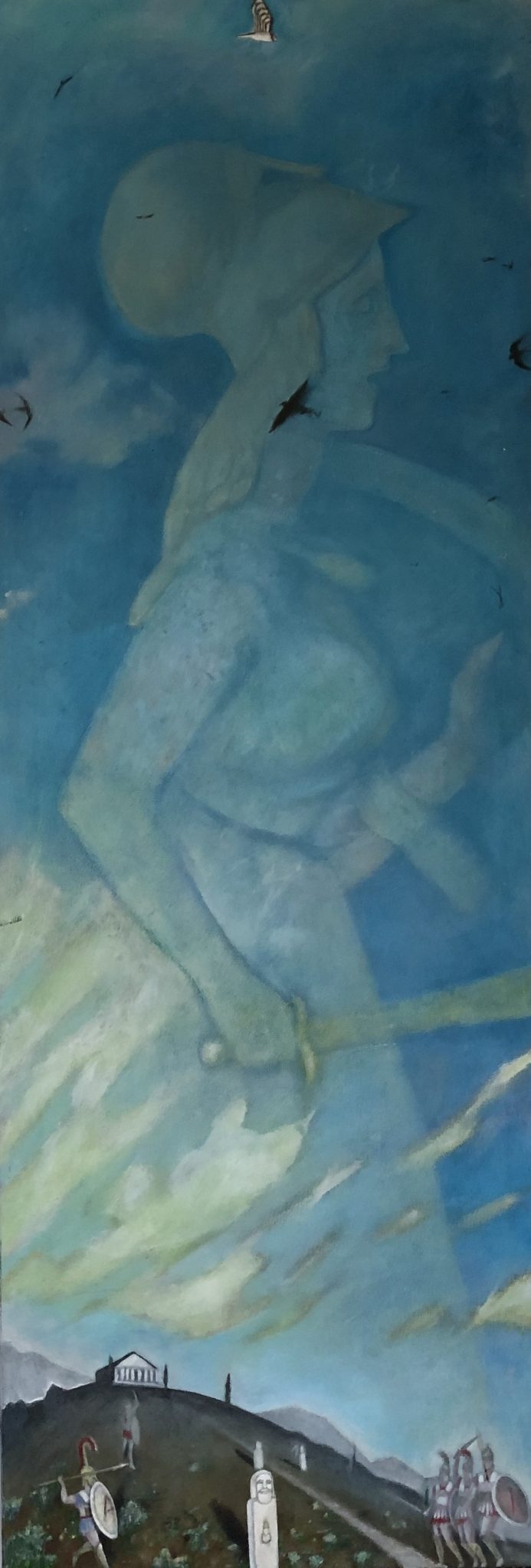
Athena contra Sparta. (88) 24x68.
The mythos is of Athena taking Athens part against Sparta in the Pelloponesoid war.
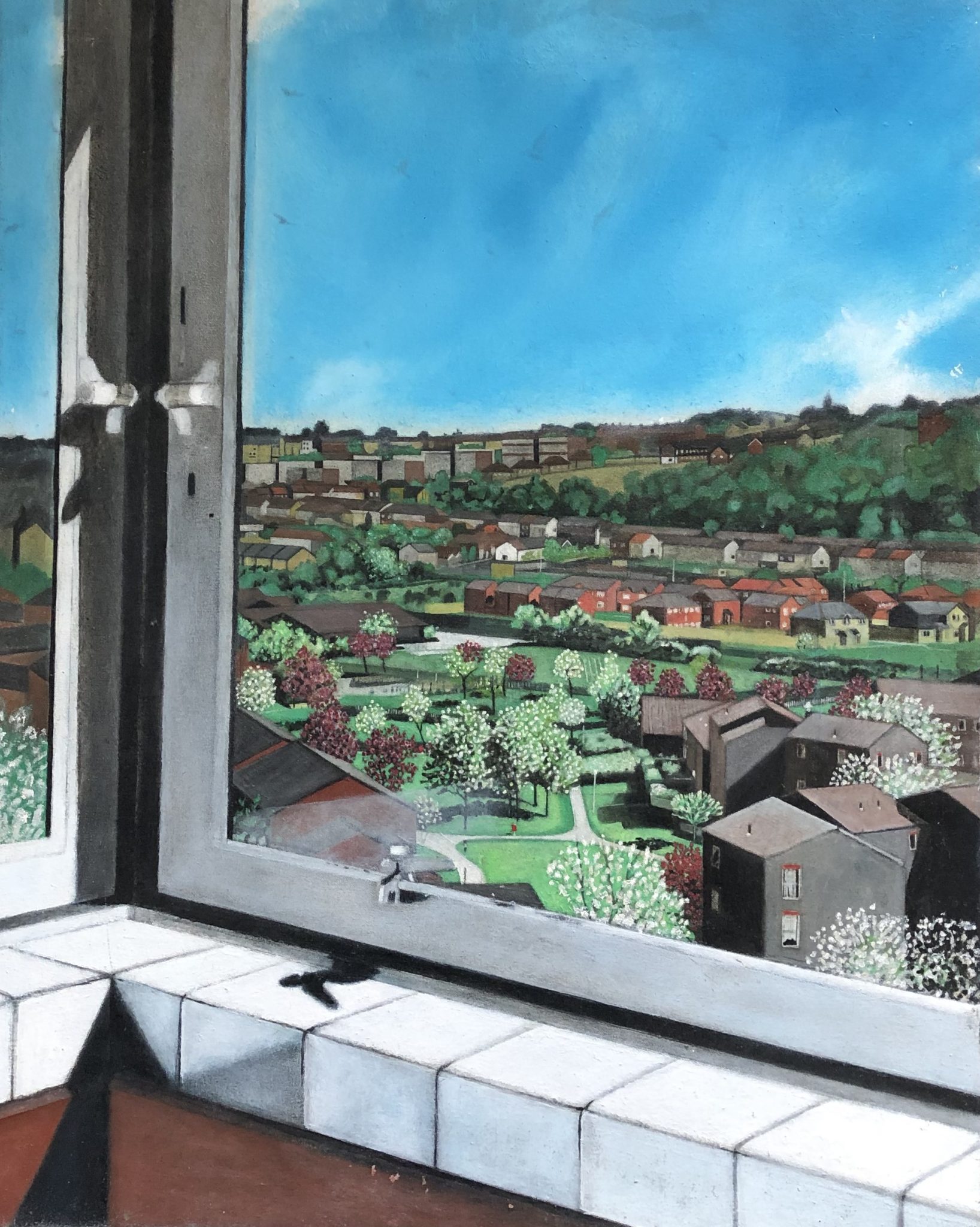
Highrise outlook.30x23. (56)
Landscape portrait of a council estate, an experiment that took a year as I had to await the same light the following year. I could have taken a photograph. Chary of architectural art, it was an experiment in ability and patience.
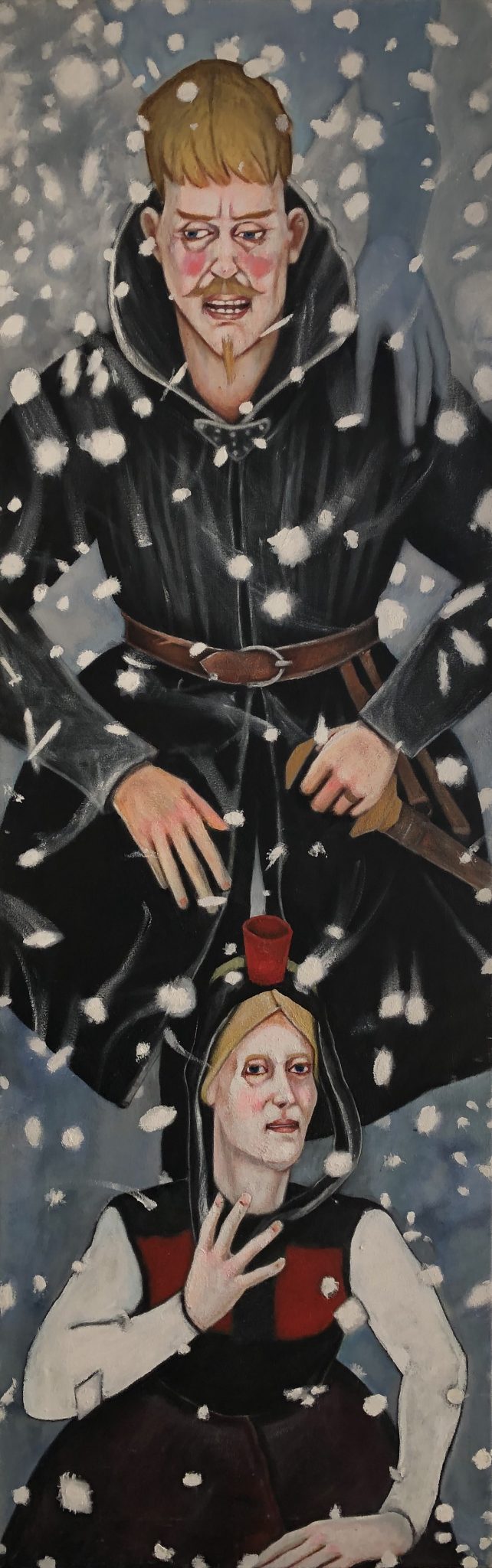
Red capkin. 20x62. (97)
Julia Melinda Stepke as Rotkaeppchen and Heinrich August Ferdinand Manske as a Graf, a fantasy set in a winter in the renaissance era of Germany, as the pair glide ethereally down a snowbound path.
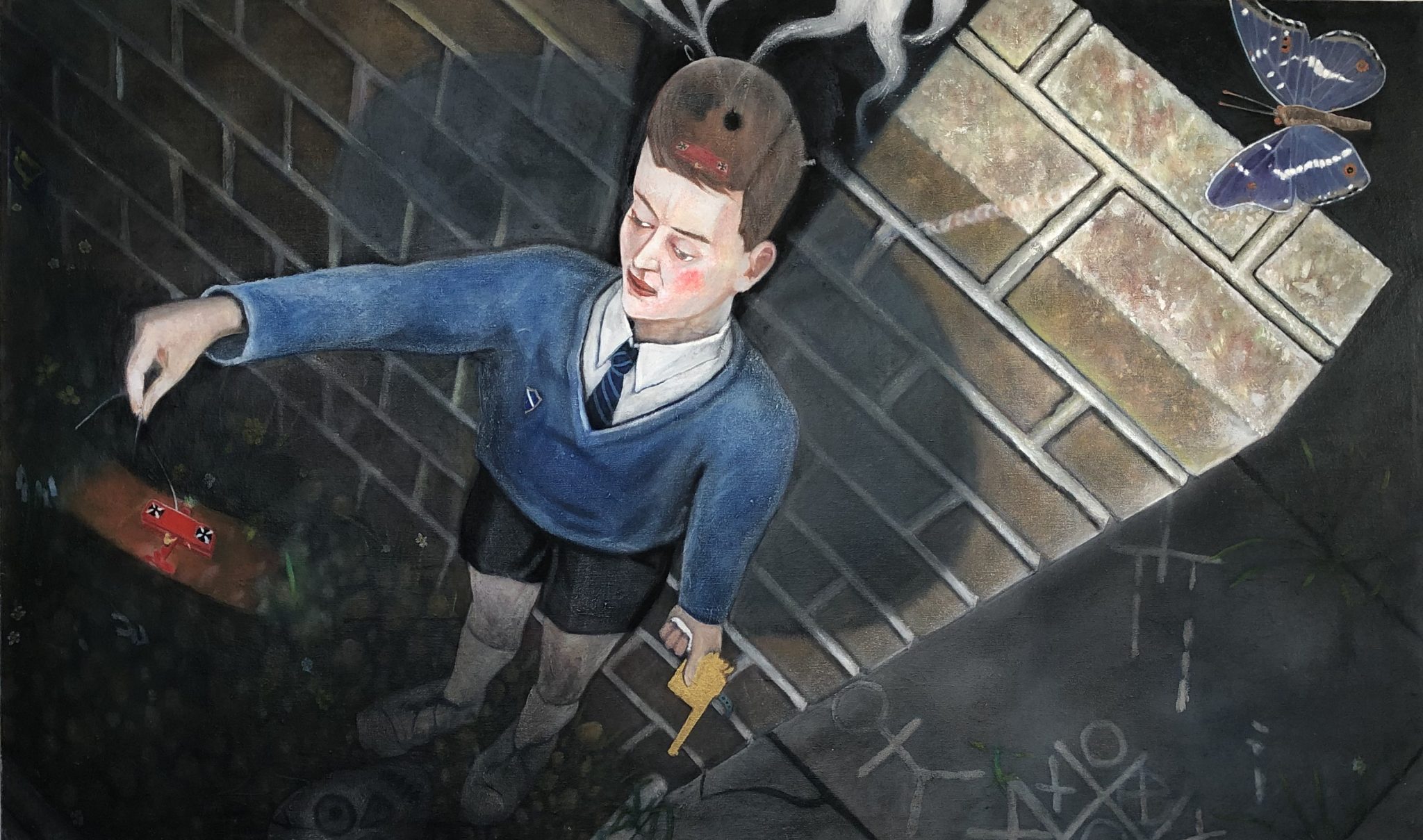
Nelson road/Nostalgoid revenant. (96) 29x47.
This picture is about how the mind can only see what it forsees and how ideas form literally in its occult and virtual space, and is also about geometry, also occult, thus the egg of perception behind the figure as if some raw, young heretic enters the existential shadow. That is why one sees the figure from outside, astrally, as it were. There are elements of nostalgia and the ironic inclusion of graffiti whose crude artistry prefigures the work of mature years. Just as raw acting comes easy to children, so raw art with chalk or crayon comes easy, thus the image is self-referential again, as well as depicting old toys like the cheap plastic airplanes Generation Jonesey boy children might have owned. The golden gun is a cap-gun broomhandle Mauser. The Catholic monitor's badge is on the blue jumper. The picture is meant to be stood, rather than hung, and this, in respect of its vertiginous perspective, as befits the remit of my repertoire as a visual psychodrama and as an existential conceit of virtual presence.
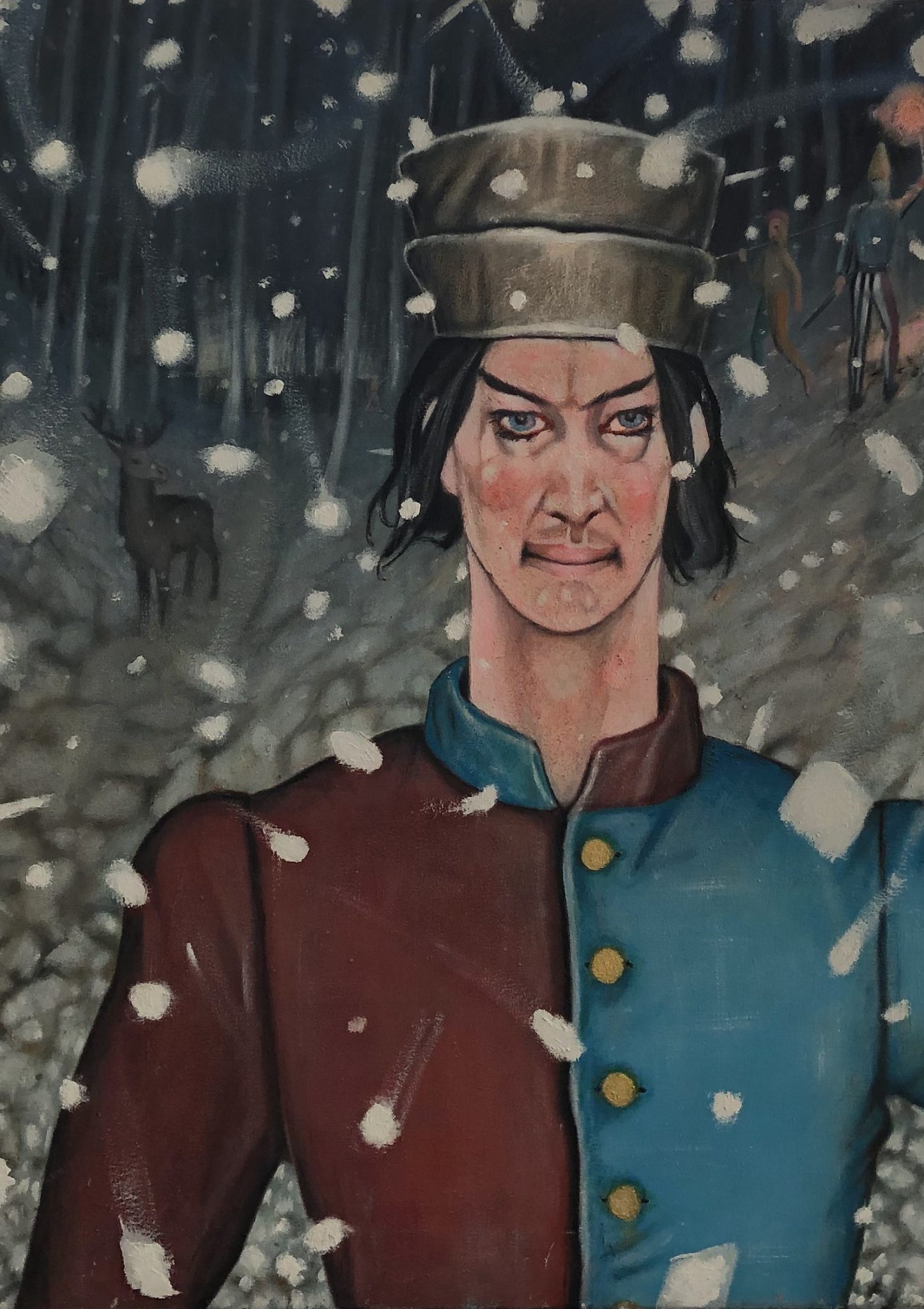
The Condottiere. (98) 22x30.
A military scene set in the renaissance era of Italy and another accidental semi-portrait of a female acquaintance's distinctive physiognomy but become manly in this version. In the background is a curious and innocent beast who knows the mercenaries are hunting humans and not animals, not that the latter soldiery are likely to have been effete vegetarians.
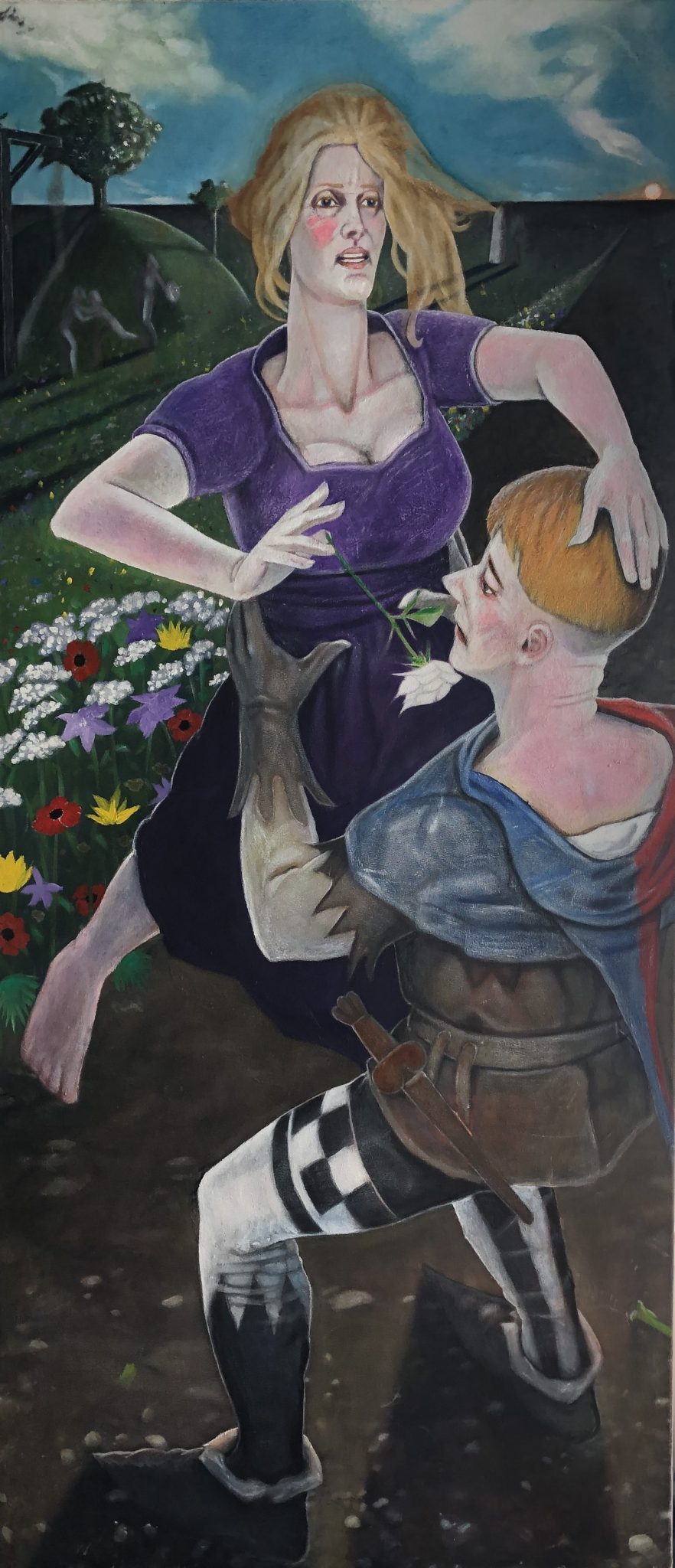
The forgotten ghost. (100) 30x67.
This a mediaeval fantasy, perhaps of Wat Tyler with a wench, evolved from an old paper picture and is another accidental semi-portrait of a younger sister. The angle is vertiginous in respect of the horizon, but is not Dutch as a whole. The forgotten soul still swings on the gallows behind, and is unknown, rather than merely forgotten, which is why anything is forgotten.
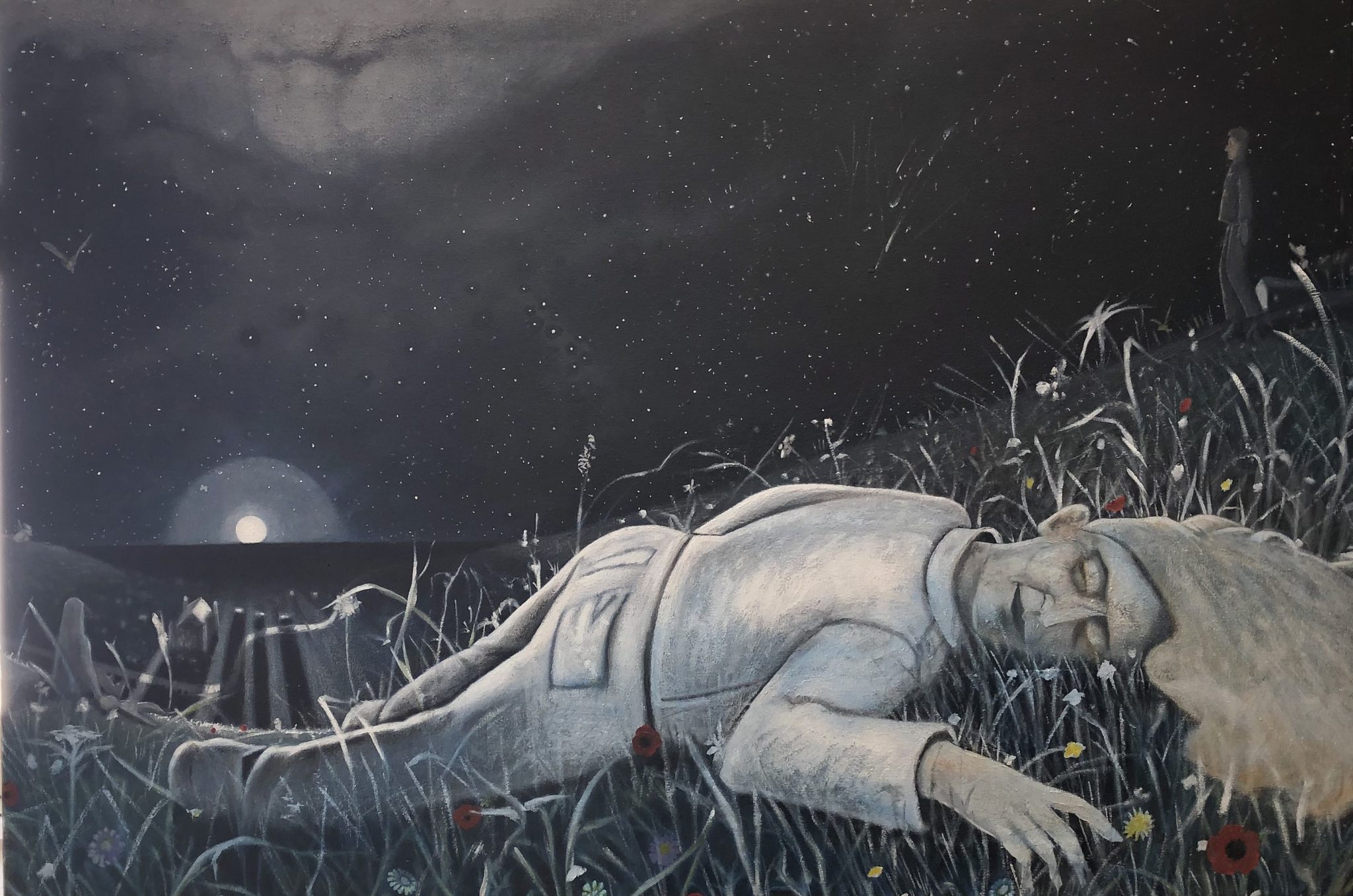
In memoriam, Felicitas. (99) 30x44.
Portrait of Felicity. Another vintage self-portrait originally on paper that became a semi-portrait of a girlfriend on canvas and in oil. She dreams in the darkness on the downs, while some lovelorn fool lingers above. To the left a mother and child enjoy the cool moonlight, while bats hunt moths and nightlife goes on for the nightly beasts. In the sky, a pareidolia of a huge ominous fairytale face.
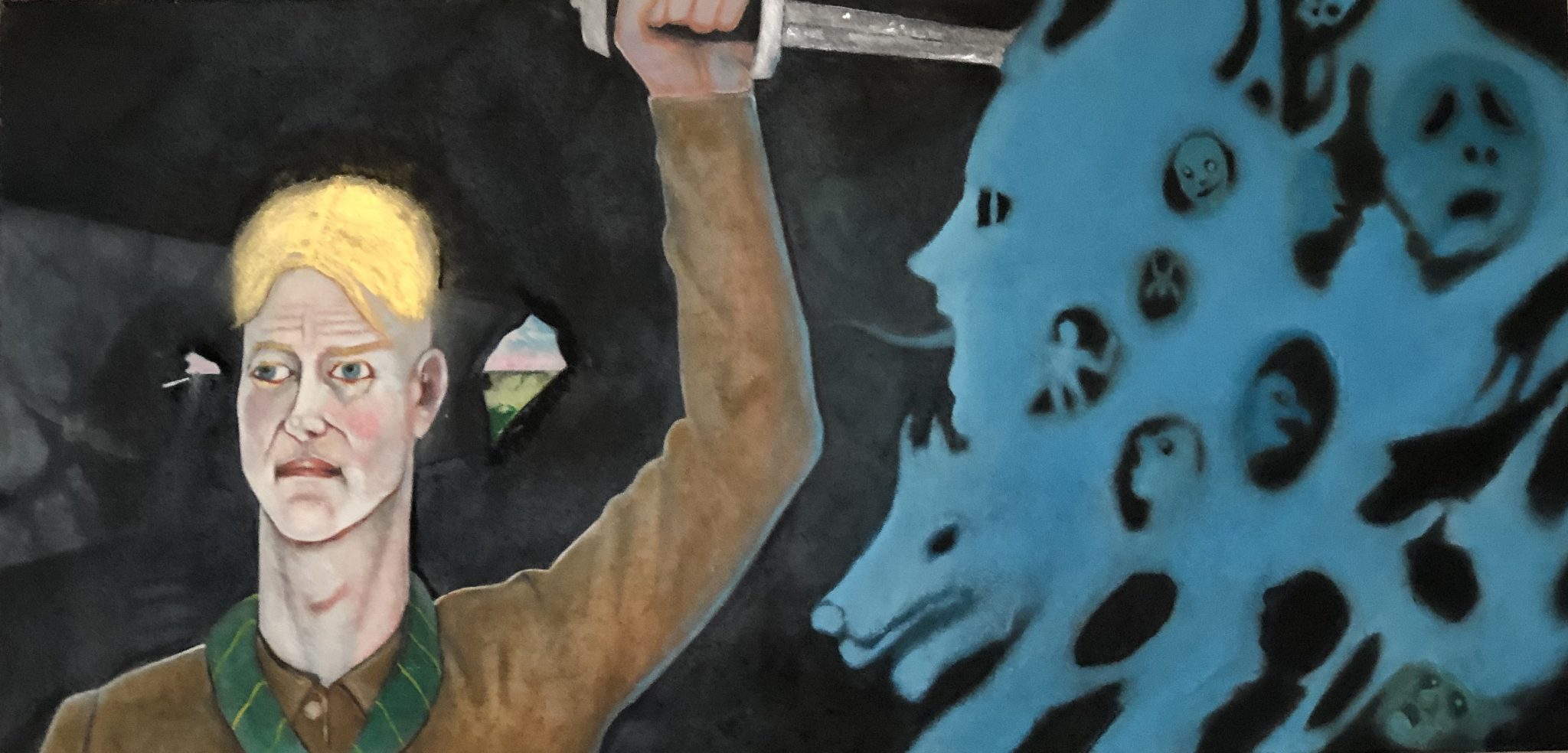
Scout in the underworld. (106)19x39.
An autoportrait as a teen sea scout in the cave of the demons of Hades. The blue devils bait the youthfully stubborn boy who bravely brandishes a scout knife that melts into ectoplasmoid fire.xercise in Hellenism that somewhat features the sun and its human subjects in a peaceful scene, while the sun is a distant roiling monster and Earth, a distant fecund toy, well-fed by light.
7x 20x20 oils on canvas.
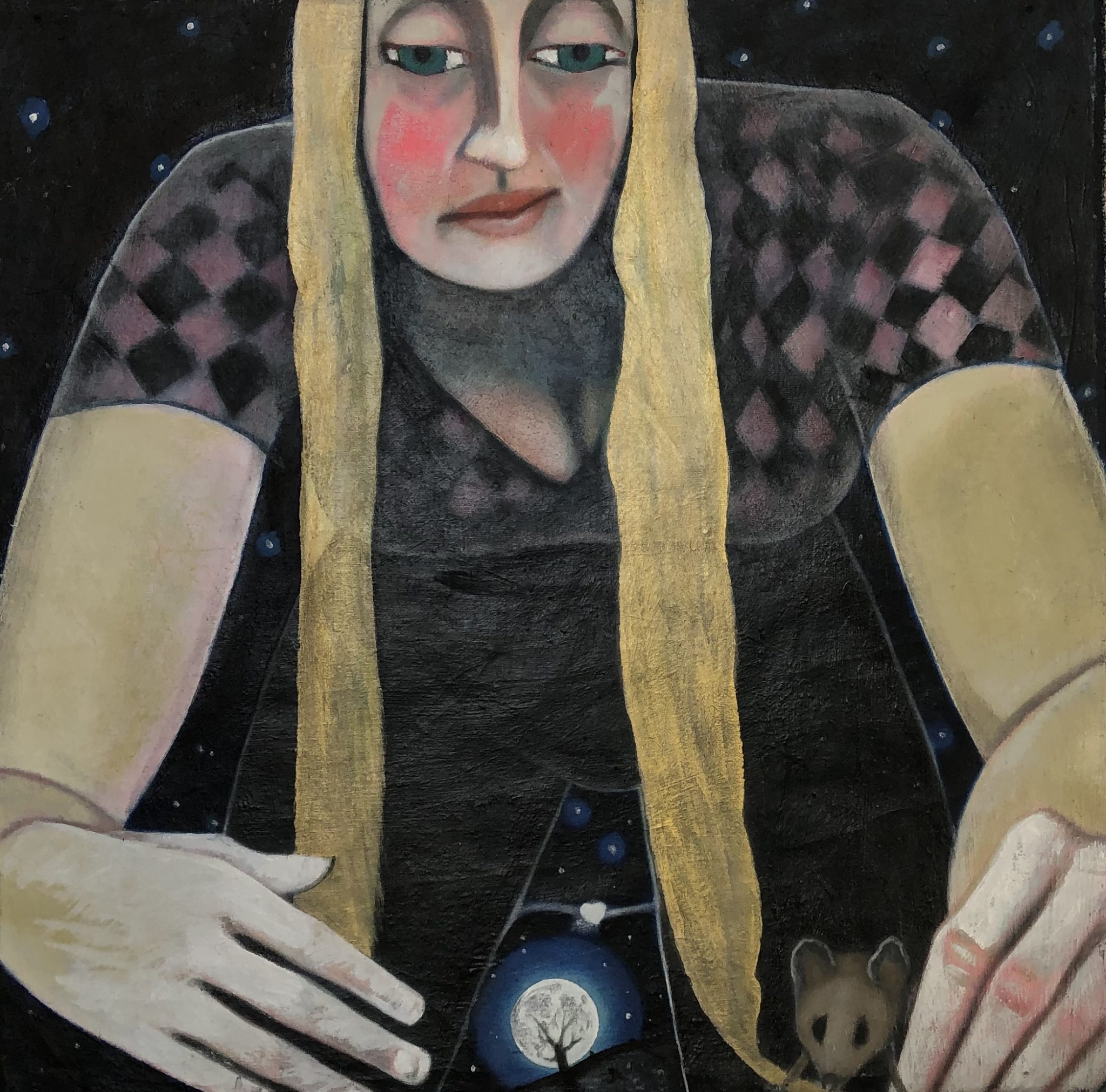
She starves the owl.(83)
A Semi-Portrait. Began as a self portrait. The owl must live so that the mouse must die.
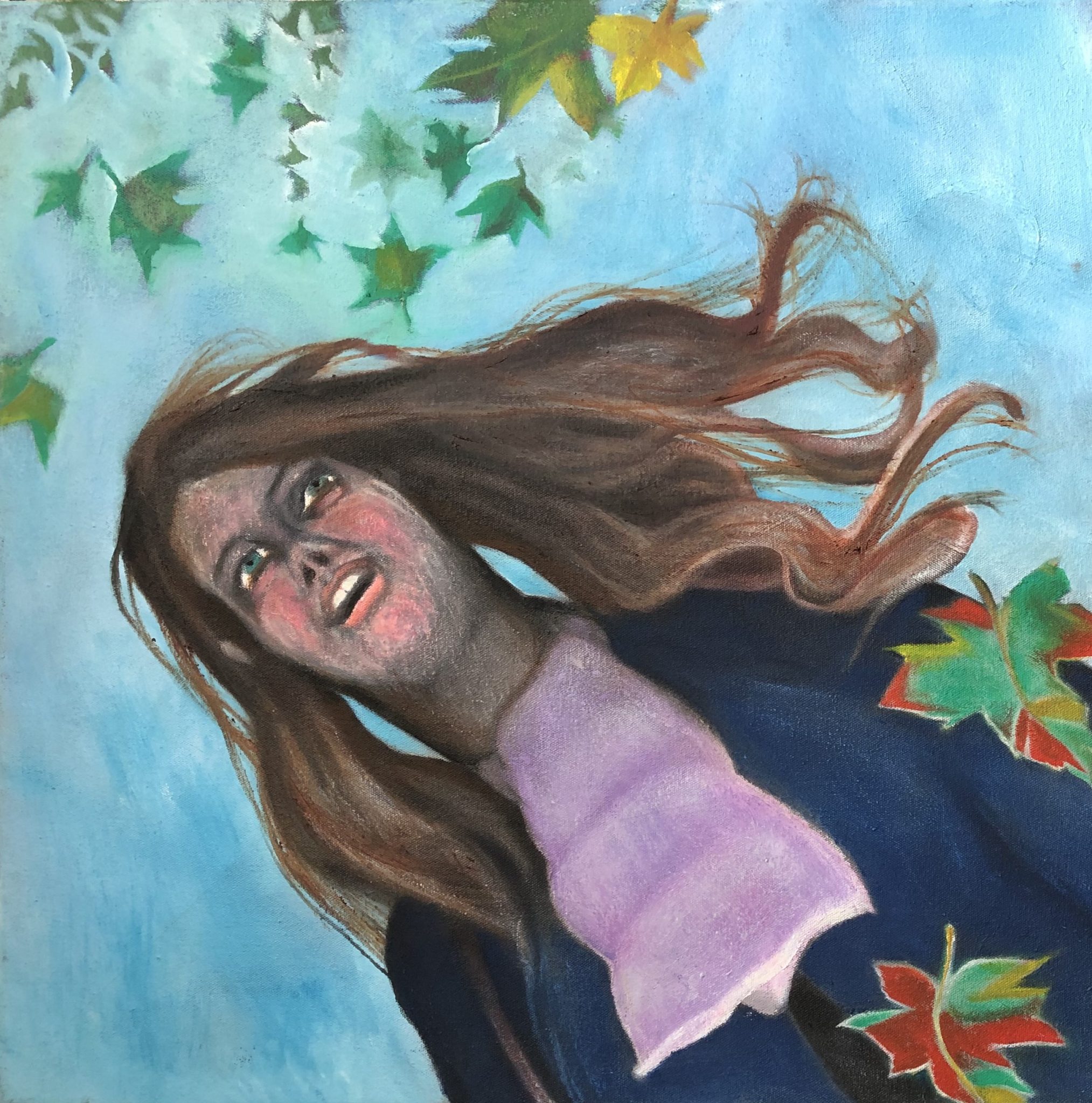
Autumn leaves, elfin ears. (89)
A semi-portrait of young Helen at Marble arch in 1979.
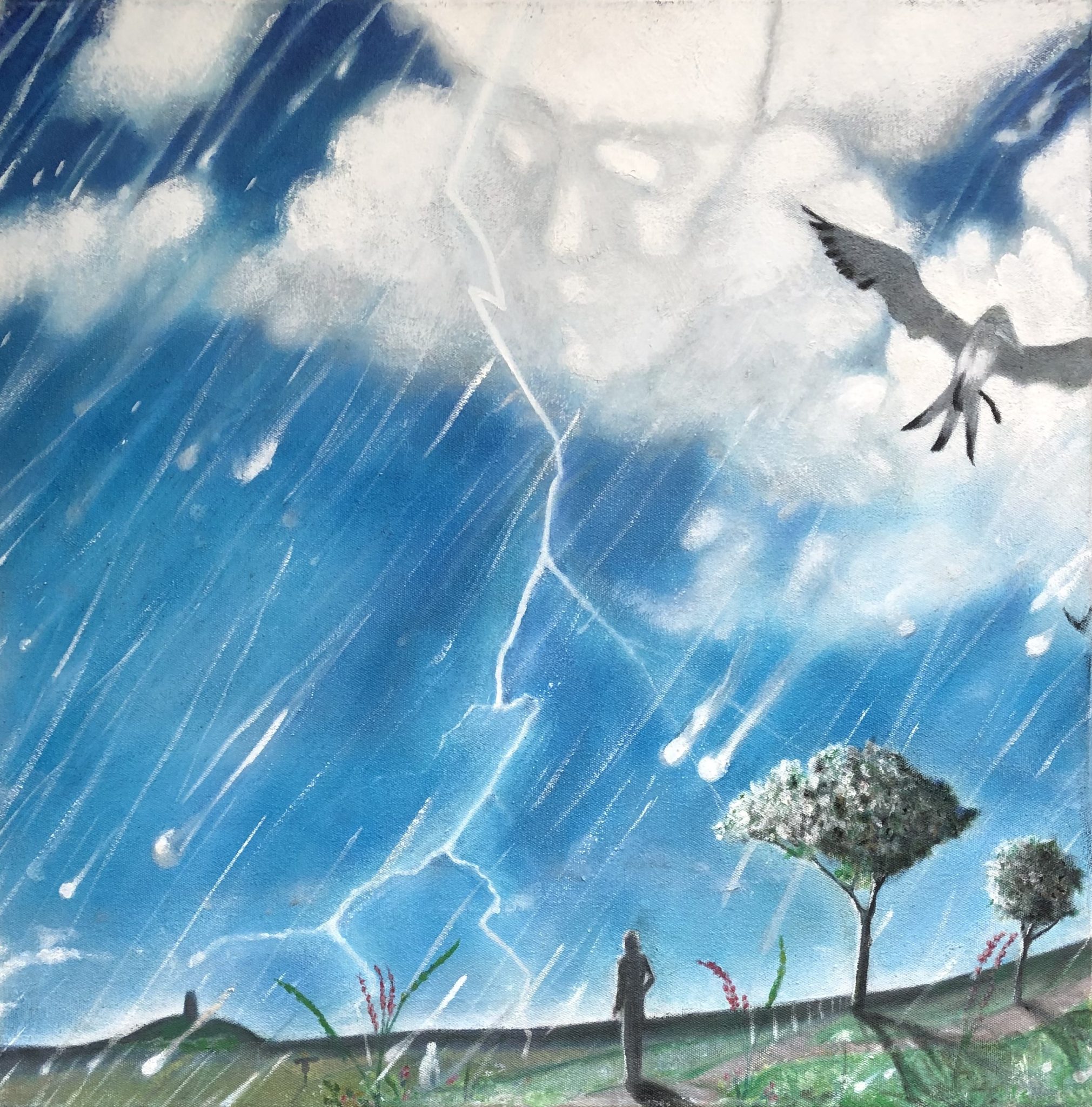
Lightning witness. (90)
A landscape scene to examine the power of starry lighning and the excitement it causes local creatures, not least a sightseer who thinks himself Prometheus or Thor.
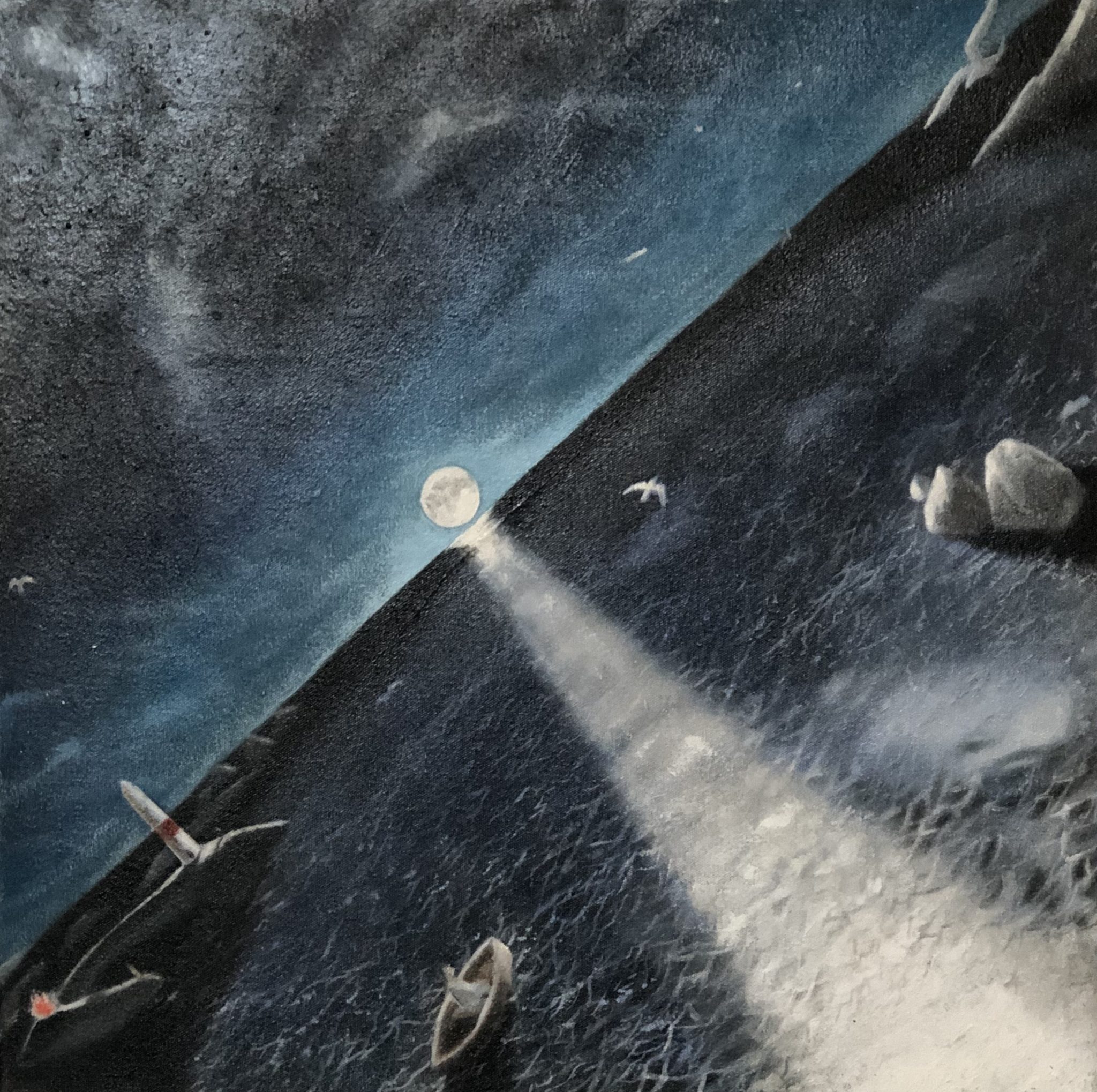
The nightly seascape. (91)
A Whimsy to feature the transparency of water and the drama of a moonlit sky that overlooks every nightly scene when some are glad of its light and other shirk it delving spotlight.
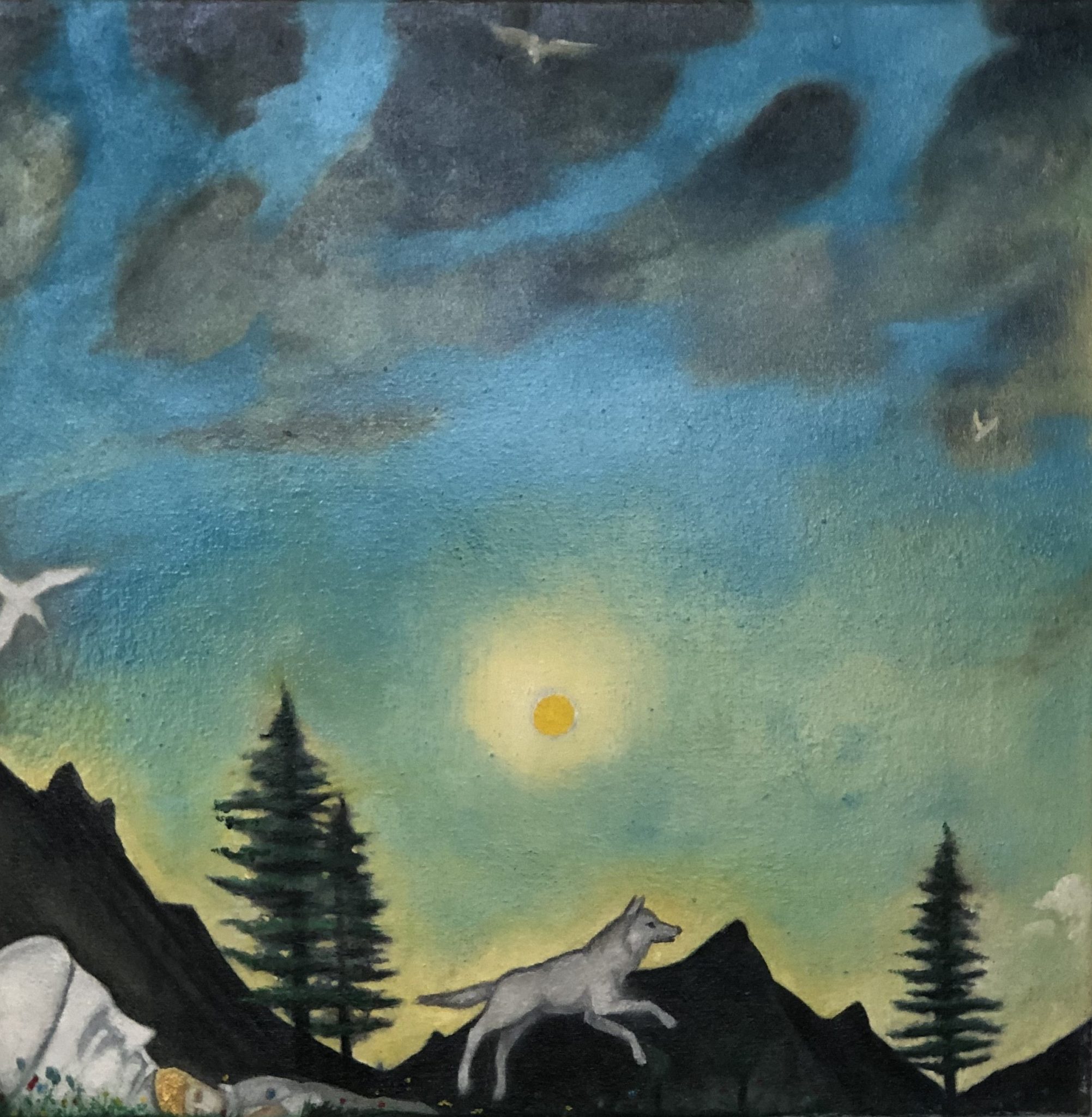
The happy wolf. (92)
This is a mythoid scene, a whimsy, perhaps set in Solutrean America or on the the Europoid continent, that depicts a happy wolf in an alpine meadow amidst mountainous majesties and with a wanderer amidst the old fallen idols, the figure, perhaps a rootless outcast or a seeker, in contrast to the simpler creature without culture, save for their economist appearance and survivalist instinct.
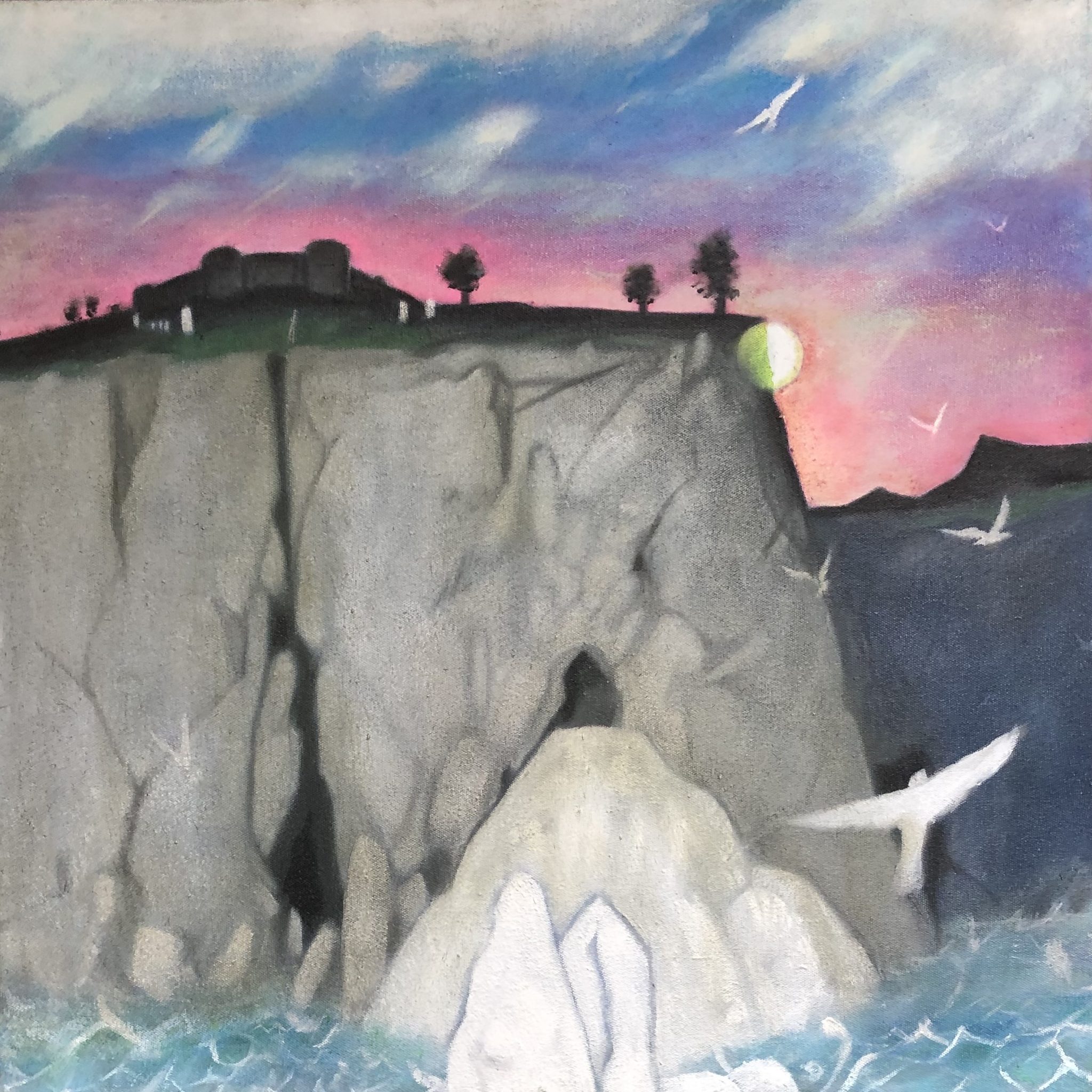
The stone ring.(93)
Old stones, another coastal scene, that features the sun and birds, the latter whose aeriality places the stations in the picture plane. The sun shows its true self as white while the atmospheroid lens paints it yellow. Birds literally live in a gas medium as well as swim it, like multimedia creatures.
2x 16x16 oils on canvas.
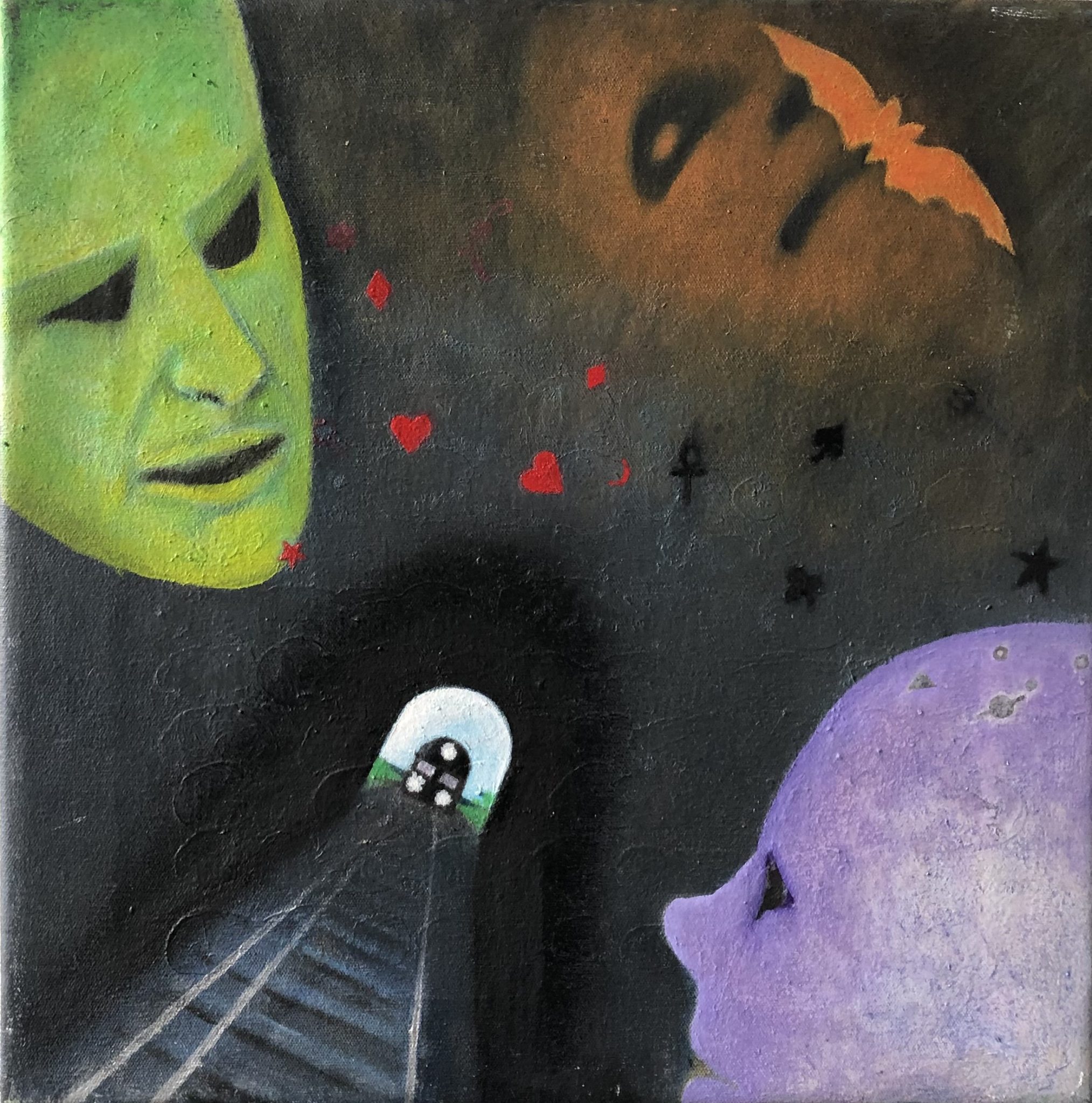
Three spectral magi.(112)
A conceit of metaphysical mysticism that simply betokens the exchangeable images of ideology whose subjects also embody the trio of secondary hues, mauve, green and orange, being highlit in the contrasty blackness of a fusty tunnel whose fleet tenant, the speedy train, will pass through the these three ghosts, without recognition, retardation or registration, except save momentarily for one or two sensitive passengers, who pass through their heady magnetism.
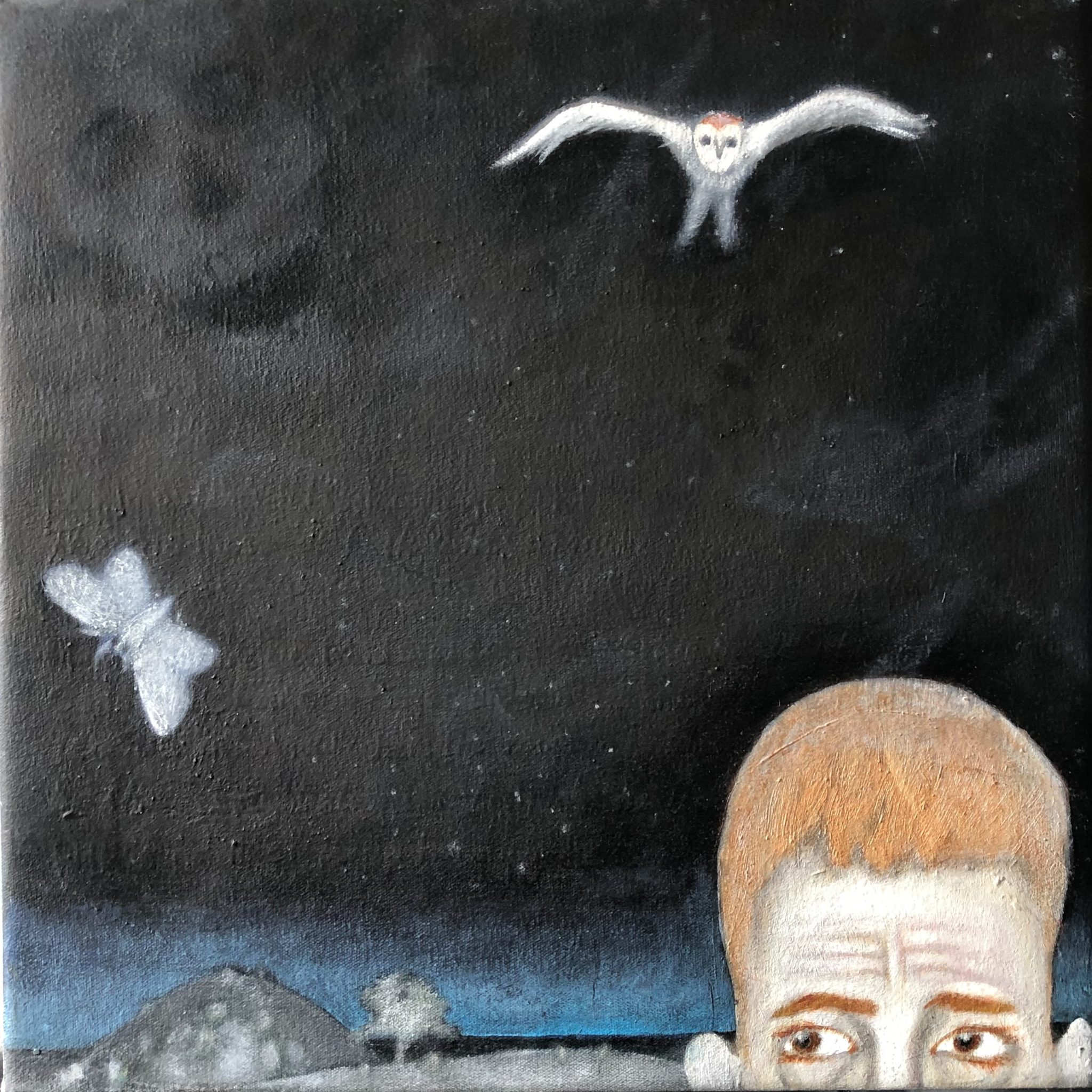
The frightful birdwatcher.(114)
Some townies might feel the landscape ominous if they bring their urban worries with them, and others might see Death in the amorphoid clouds of imagination, while real hunters hunt real prey.
3x 12x12 oils on canvas.
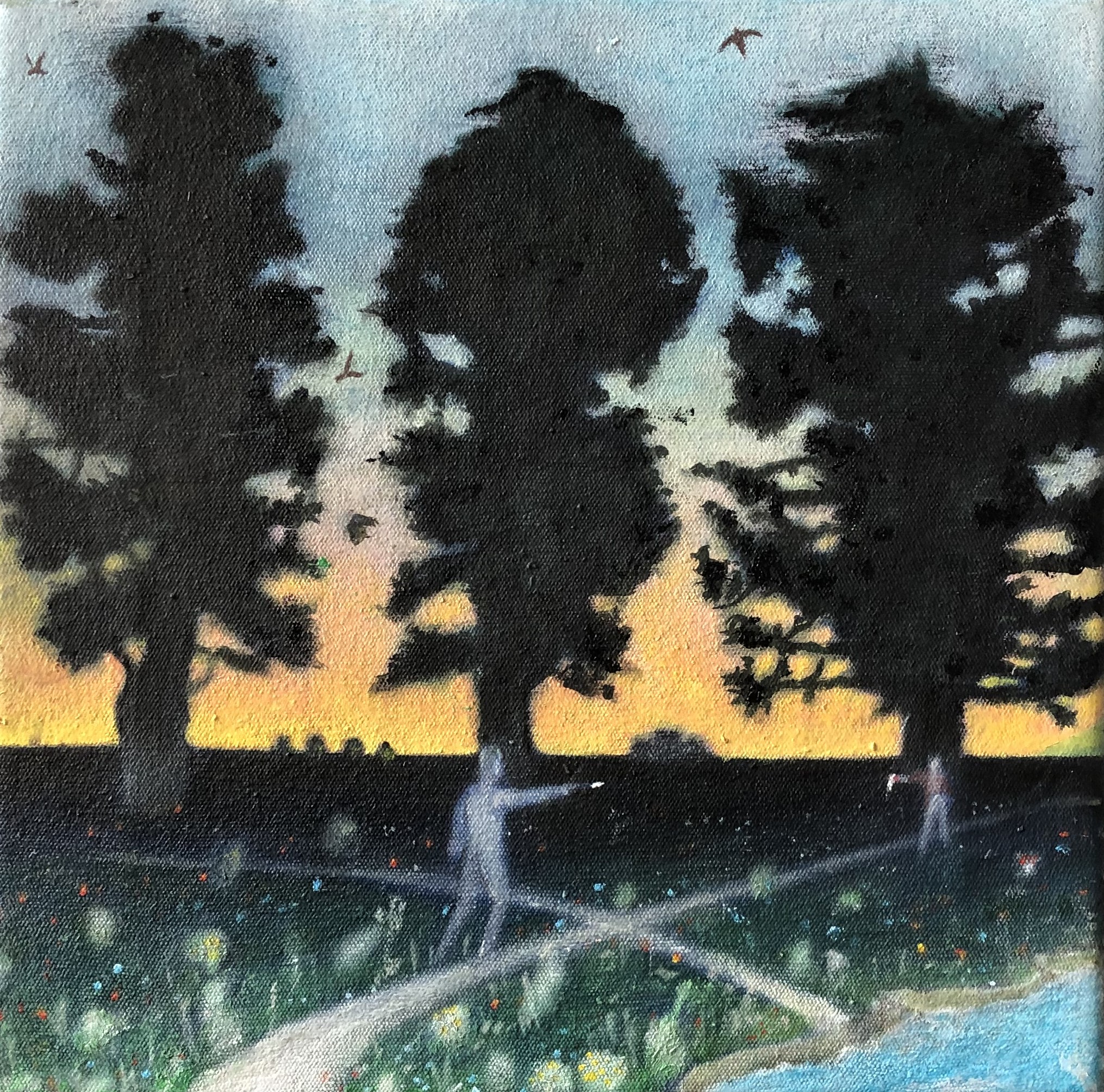
Two duellists at three trees.(110)
A simple miniature, redolent of the ages of duelling or even of the wild west and in which the contrasty trees like ancient monarchs, overlook the vainglorious humans, beasts no different to the fourleggy stags the trees might also witness, feuding in the farmer's fields, but only if their leaves were also meaty eyes. The moment may be pregnant with the death of either dead shooter.
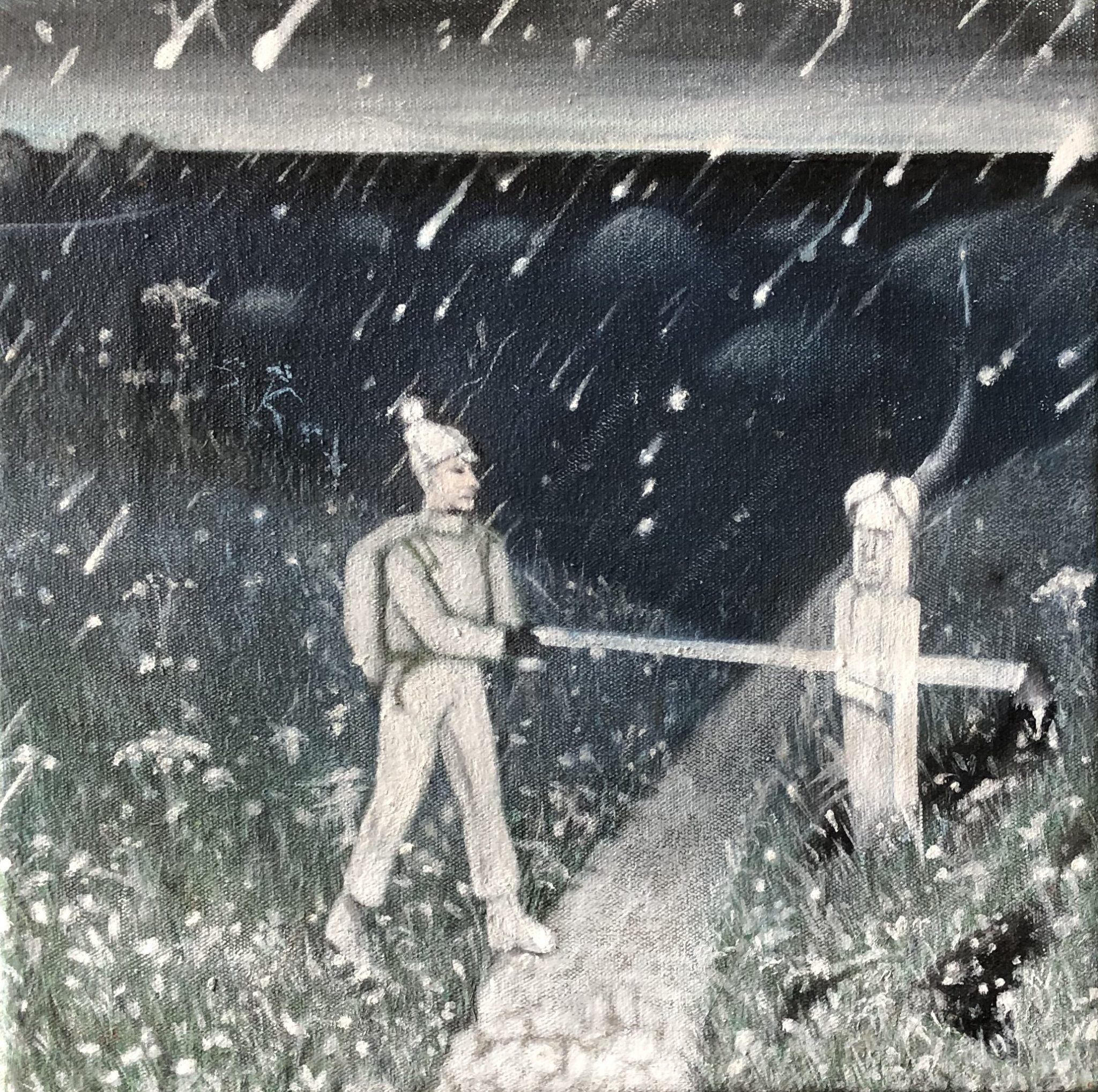
Hiker amidst the spooky barrows.(111)
Another miniature, a nightly landscape scene in a midnight rainstorm, the hiker amidst the creepy barrows and ancient idols, and the only other soul, the fugitive badger caught in the torchlight of the refugee hiker.
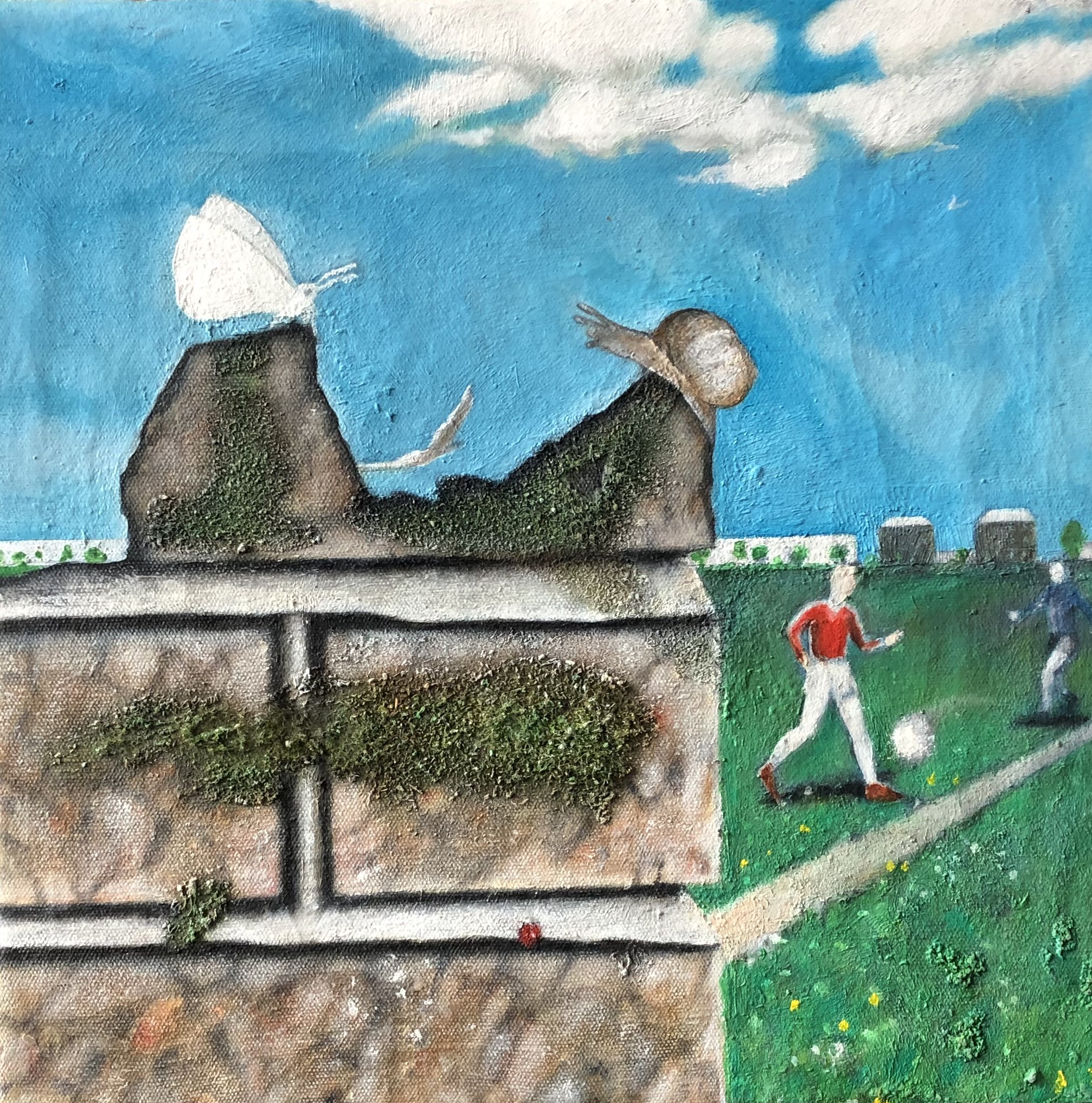
Snail meets butterfly. (113)
Black heath, 1960's. A miniature, redolent of biography, a whimsy of the meet of two non-humans, while two boys punt a football in Summer, oblivious to the alien mollusc and to the alien insect.
10x 60x40 oils on canvas.
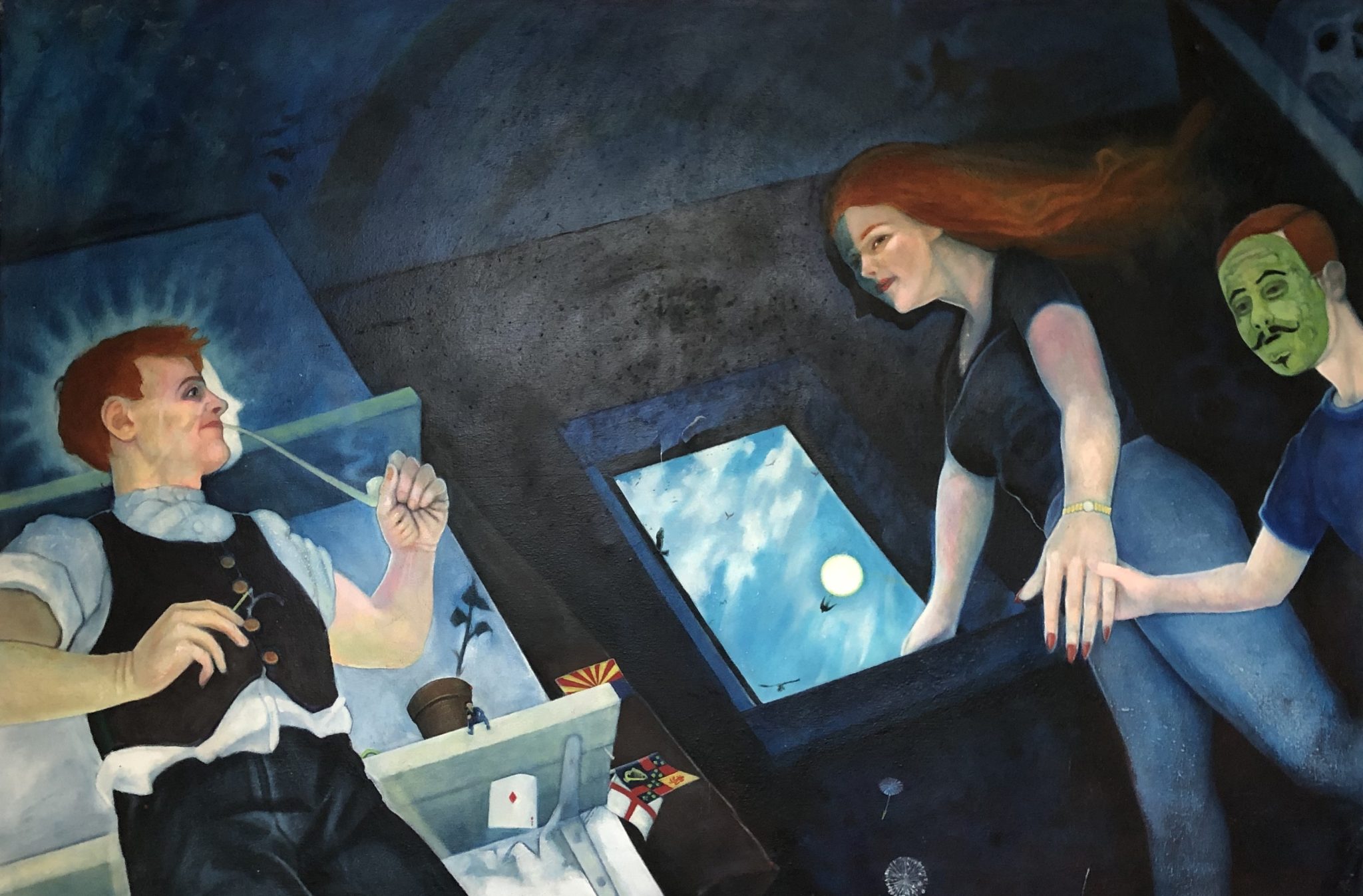
Ginger duo. (42)
A triple portrait with the child anonymous and irrelevant to the dysfunctional parents, embroiled in their own immoral autism. The scene is a mirage of the scullery, decades ago, in 19a, Nelson road. Souvenirs of the time are the seaside flags, beauteous in their own right as hypographoid images, and the model of a Herald tractor driver from 1961 sat on the shelf edge like a plastic fairy from a bygone age; such yeomen by 1918 were bygone even then, in the swinger's sixties.
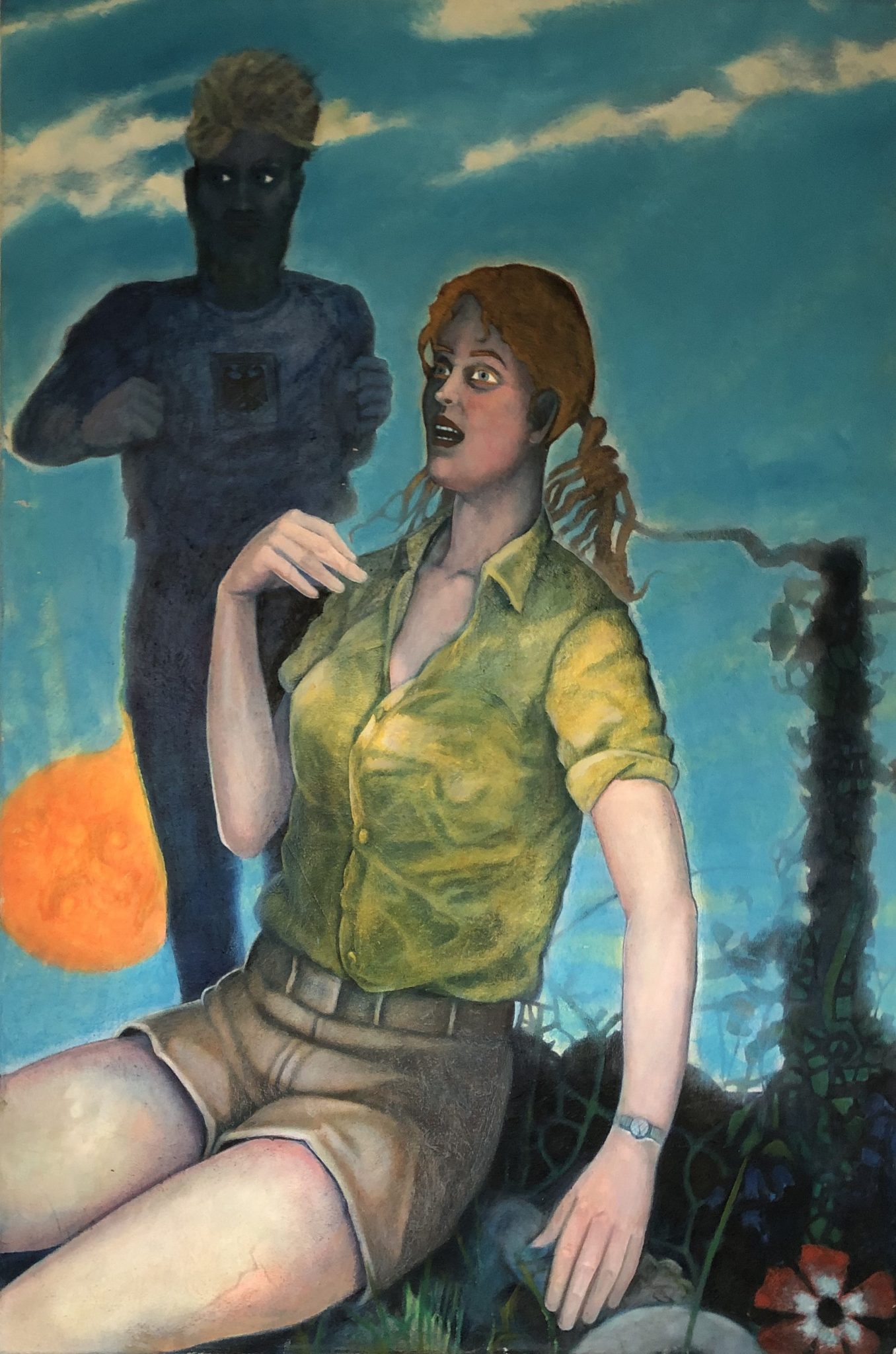
The two hikers. (44)
A fit hiker and his dreamy girlfriend spy creepy fiends in the landscape. An early work done close up, in which a stylised Sun features as if alive in a fairy tale book by Rackham, and a trifle Gothy.
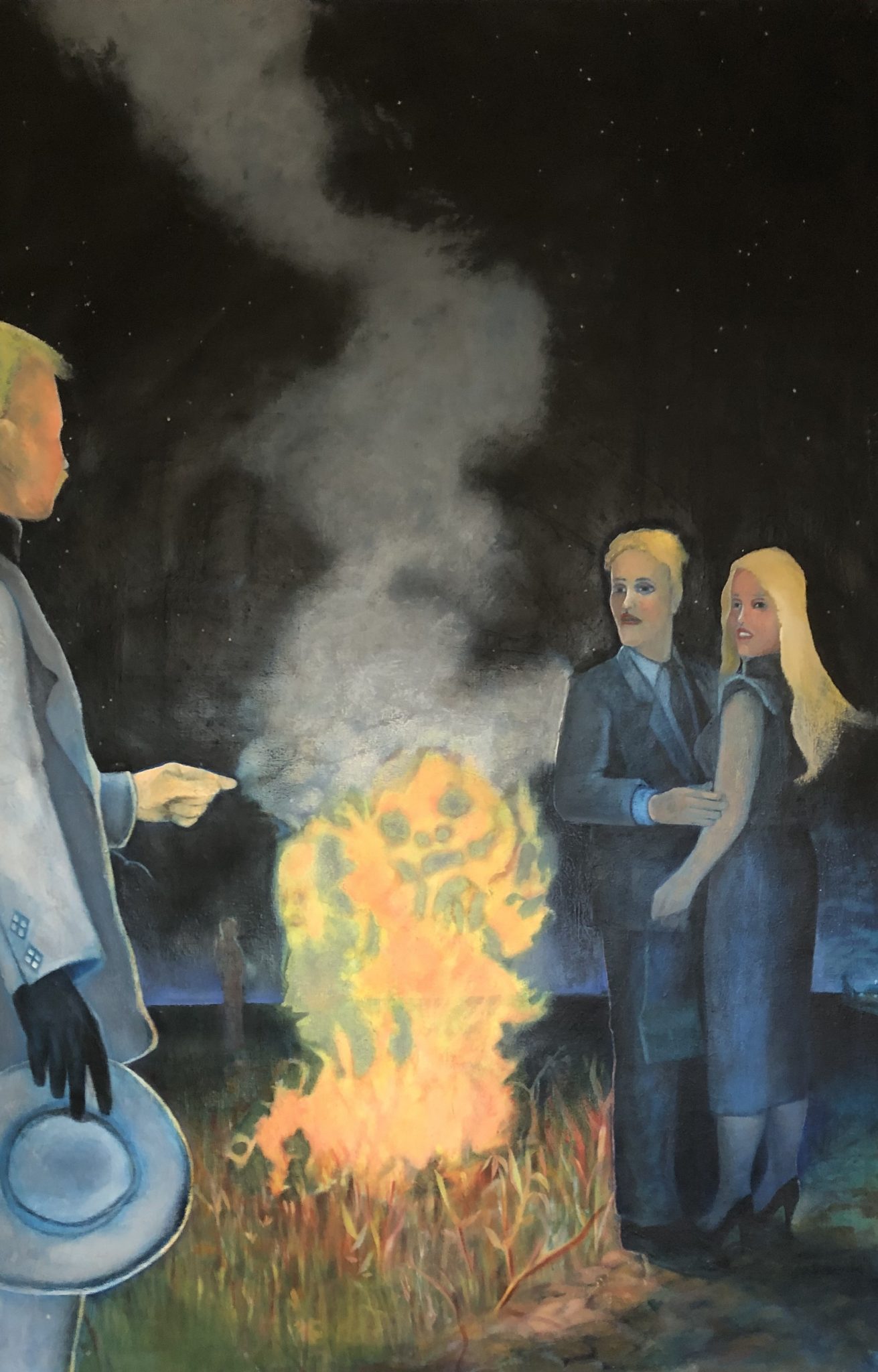
The Seer.(55)
Two friends by a customary bonfire, and beset by a wandering Seer, summoning the mythos of authoritarian prophecies that hex the innocent and that feed the vainglory of monotheist wizards.
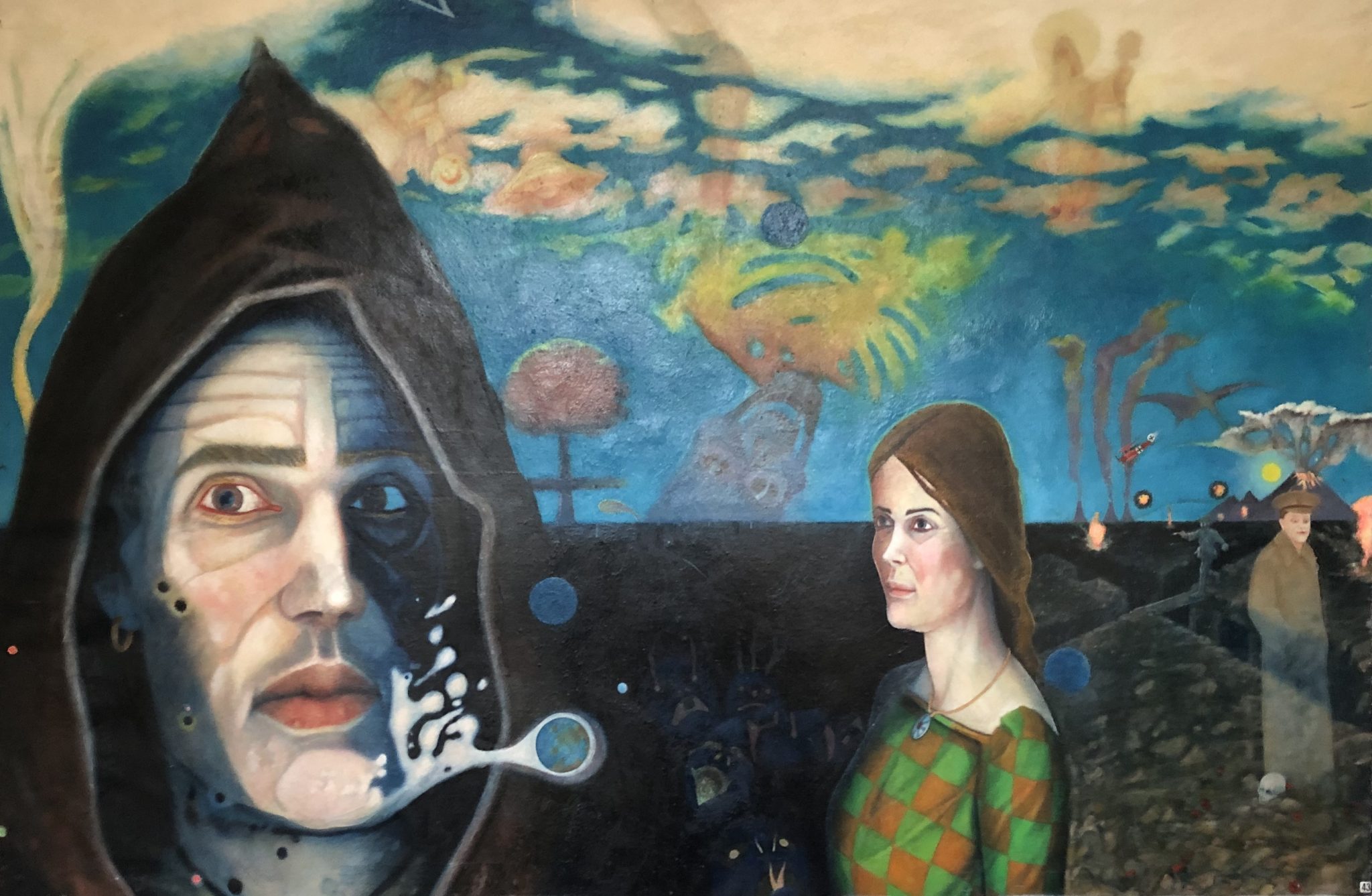
Triple portrait with apocalyptoid sky.(85)
This picture contains 3 semi-portraits from a viewpoint right of the canvas, to the outsize head on the left. The central portrait is of an Irish lady in Eire's traditional green and orange or is the livery of the Fenian republic, and is lifesize. She wears an ancient British enamelled brooch of a sun pattern in red, white and blue. The triple portrait format models a metaphysical perspective where the head of Welsh poet, David Jones, in miniature recession, leads to the live and lifesize head of the woman, and deeper, to the head of a dead friend, David Thorn, in monkish habit, which head evolves into a giant size betokening infinite mass, just as recession to the horizon leads to devolution to zero or invisibility, as opposed to leading the sum, whereby, Nicola Gallagher, the natural size figure, betokens, (like the paint that depicts her possible real appearance), balance. Both men are dead, so that their images are also memorials; Jones the smallest, thus illustrates the twin poles of the infinite and of the absentee or the zero, by which we also infer Bruno's presence and his book, The shadows of ideas. The connotation here is again, renaissance, despite the relative modernity of two of the subjects. London Welsh Catholic, David Jones fought in the first world war and wrote The anathemata and In parenthesis. The bigger figure betokens the infinite scale of perspective that becomes internal and this is in some respect, a contradiction or continuation, of Alberti's theory of a singular natural station from which to see any ideal image from and inside one's own real lived space. This picture betokens that inner space as it projects to the vanishing point eyond the peicture lane while the picture recursively sees the presence of the Seer, whose awareness is, unlike his/her eyes, invisible. The three figures subdivide the lower half of the pictorial space into two spaces, the Hell scene and the war scene. By the monkish giant, the picture space lengthens into virtual inner space like a geometroid morphologue, representative of the transcendance of his organic face, of the masks of Ego and as if a visual echo. The picture is also an analogy of popular paranoia that includes in its paradoloid sky various images of oncoming prophecy to feed their many believers. To the right images, great war poet, Jones, stands like the hapless witness of a dreadful bloodbath, before the inevitable next one.
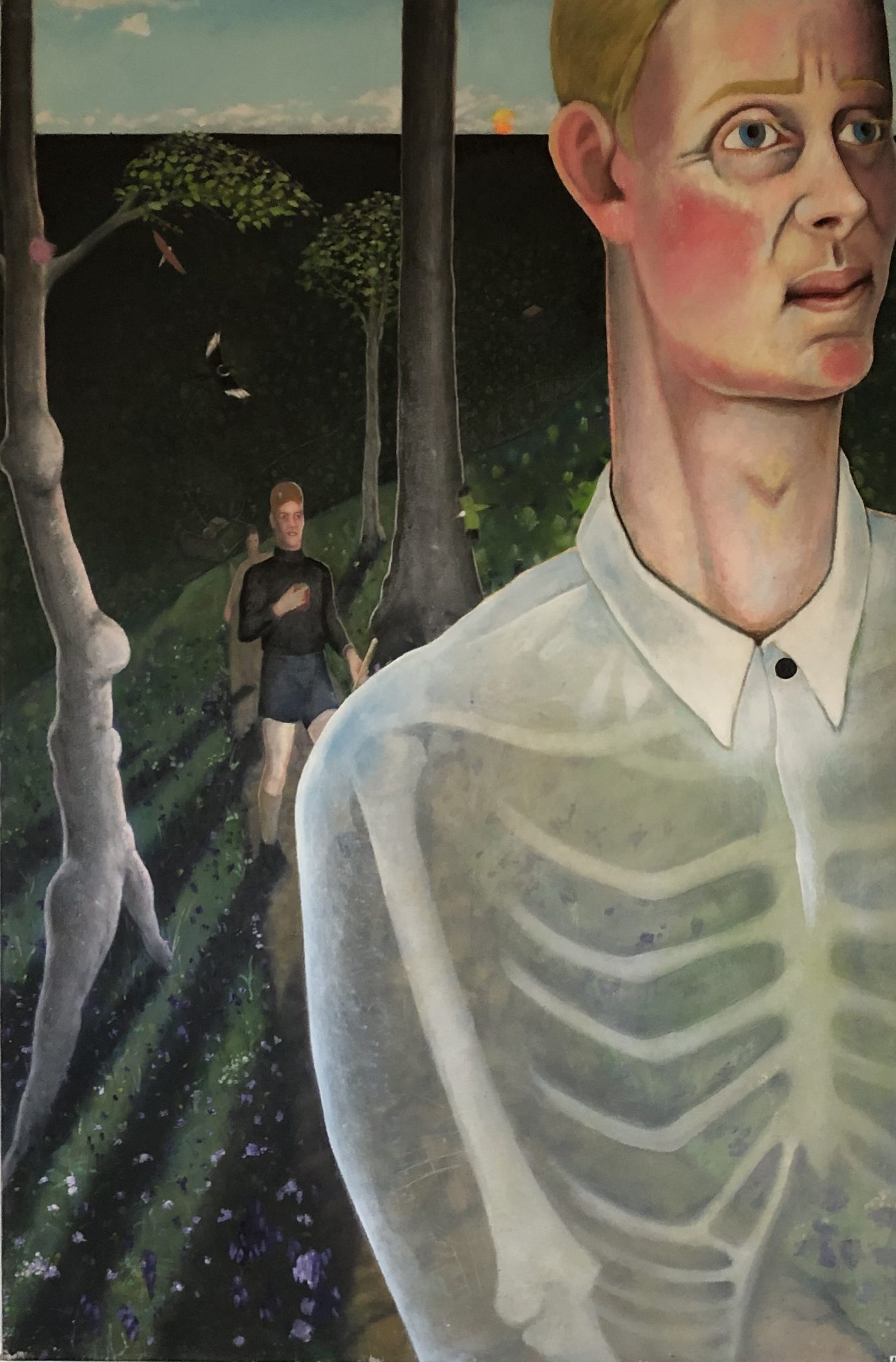
The sun sees through things.(103)
A portrait of a friend, Christopher, set in Shoreham which perhaps gruesomely illustrates the idea of the radiative power of the sun, and again features the flight of various bird races.
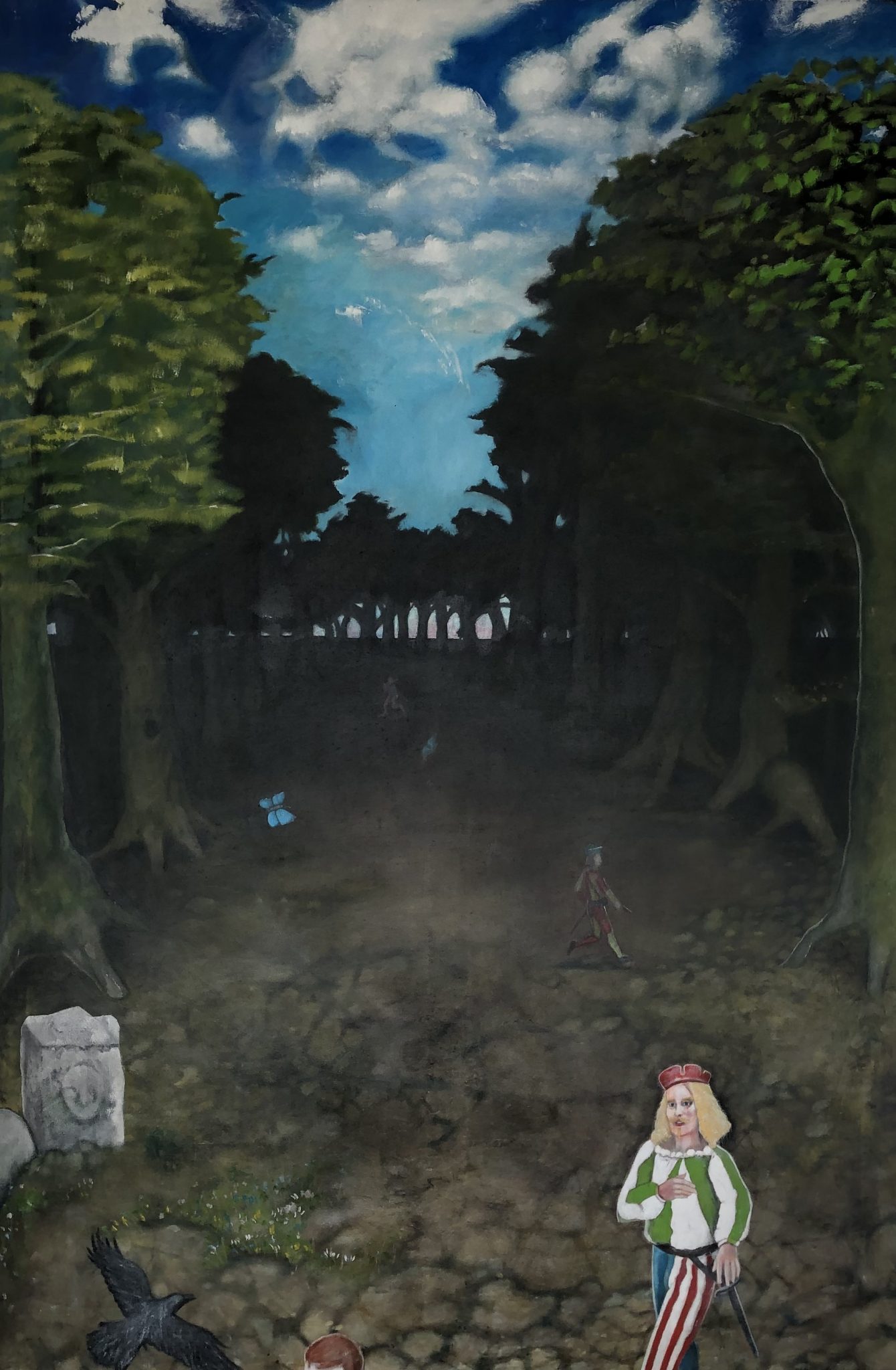
Landsknechte.(107)
A somewhat anamorphoid bird's eye scene in or on a woodland path or arboreal collonade in the renaissance era of the condottieri wars in renaissance Italy. Birds again feature to an extent.
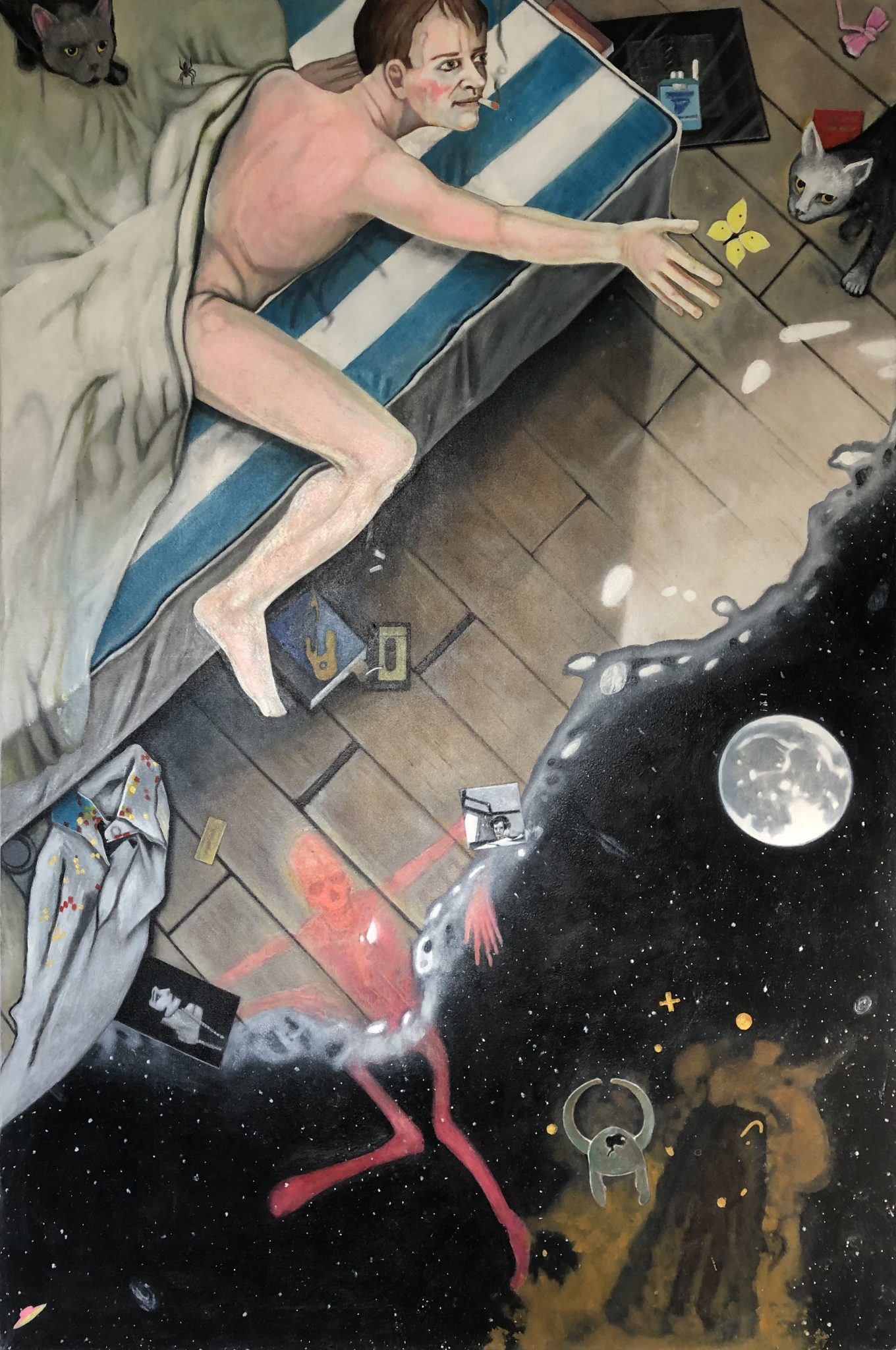
Portrait of a young squatter.(115)
An Autobiographoid mystique, typical for artists who are their own heroes of merit and martyrs of obscurity. Set about 1979 in my then older girlfriend's squat, an aerial self-portrait with two of Alexandra's cats, so, a triple portrait. No cat ever painted the painter in return. The metaphysicalism is in it is the floorlessness of the room and in the night sky of the dark side of the Earth, while the skeleton betokens the ancient Europoids dug up all the way from Siberia to the British isles. On the extant floor, articles of nostalgia, Dadaism, Crowley, pink bowties, a Joy Division vinyl, Unknown pleasures, postcards, tube tickets and a monochrome photoautoportrait that shows the same room in which the oily canvas memories are reenacted and overspread, another transcendental conceit or fractal tautology. The picture is about time and what it costs and about the time ambition takes to evolve into merit and is about the debt to death for the birth that enables temporal struggle and its attendant risks. The picture is also an anamorphoid projection in that if one views if from the right or left sides, the image changes according to ones perspective, which has nothing to do with Alberti's correct spatial placement, but references Holbein's famous painting that hides an anamorphoid skull, otheriwse hiddne as a strange abstract in the frontally-beheld plane.( )
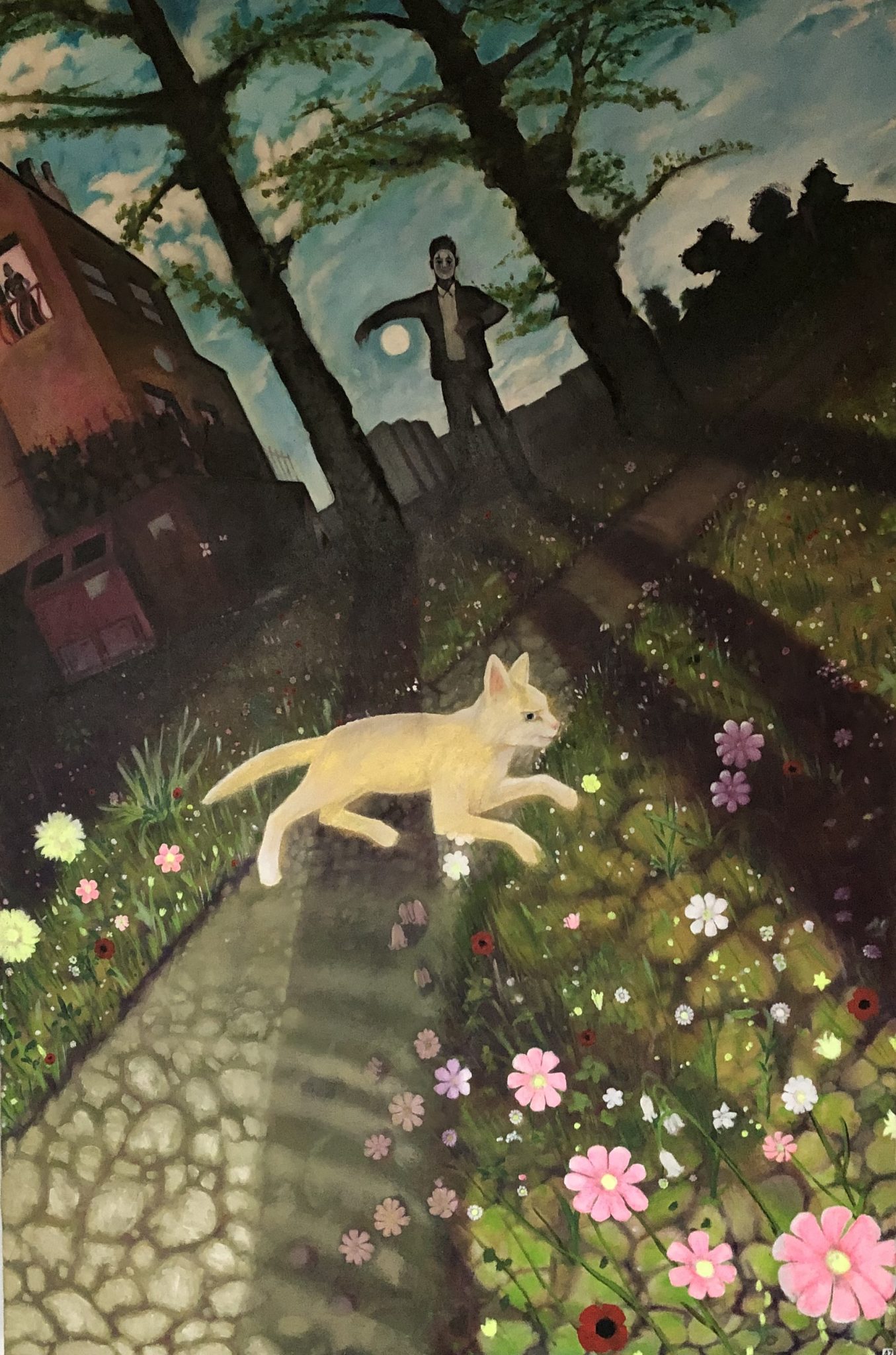
Geometroid motions.( 116)
This Dutch angular picture features the blonde cat who is a character in a book undergoing being written. The original creature was a rat and the picture was taken from an old sketch done in 1989.
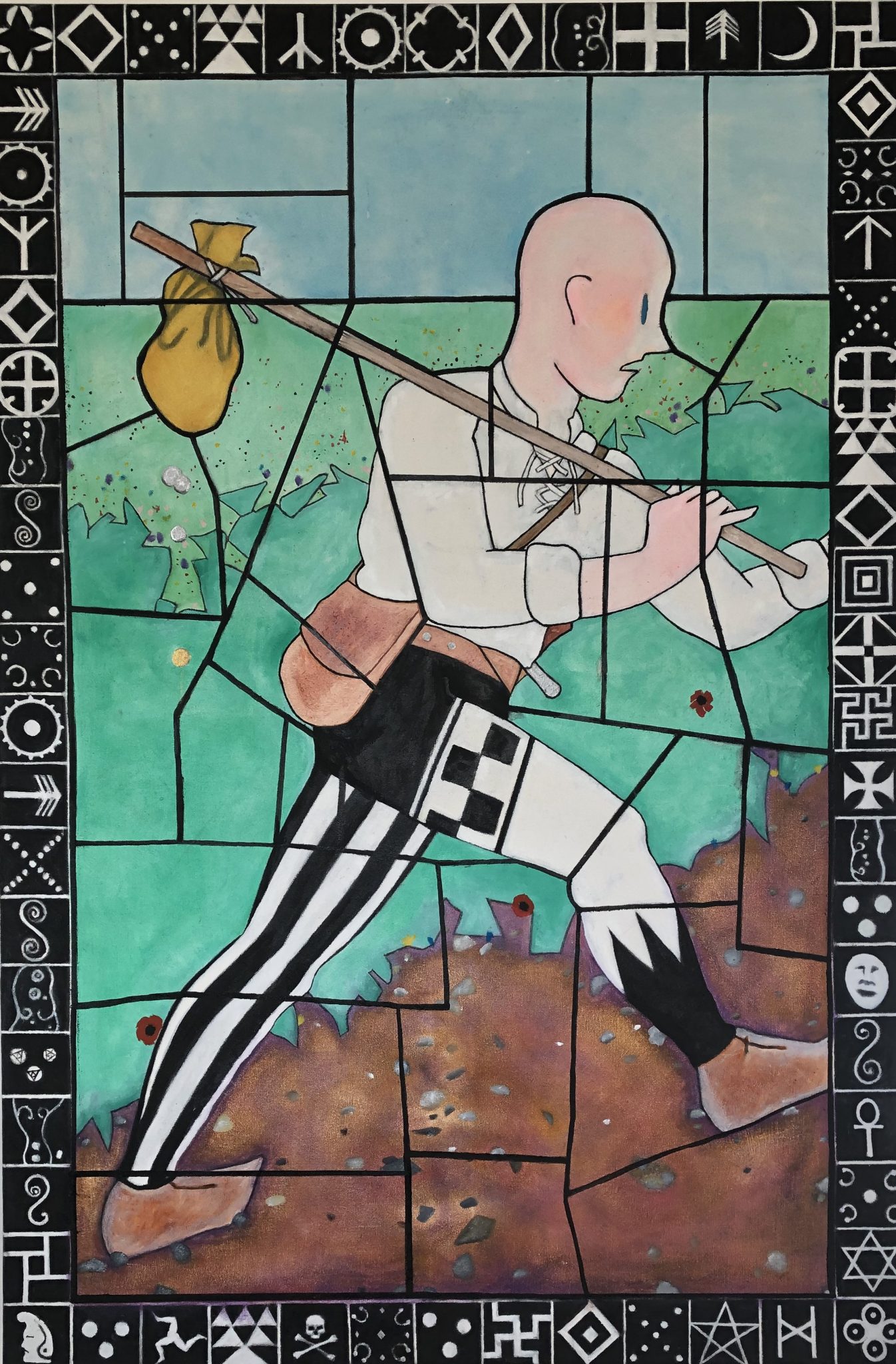
Superreal Lollard. (119)
This picture is a recent experiment. The border mosaics are redolent of classical mosiac borders and are as shown on the book sleeve image of the poetry book shown elsewhere, while the stain glassiness of the picture is a recent experimental conceit. The semi-impasto finish is absent from this relatively pastel image that partakes more of water-colouriness than of oil painterliness. A multimedia effect is again deployed in the metallic coinage and elsewhere.
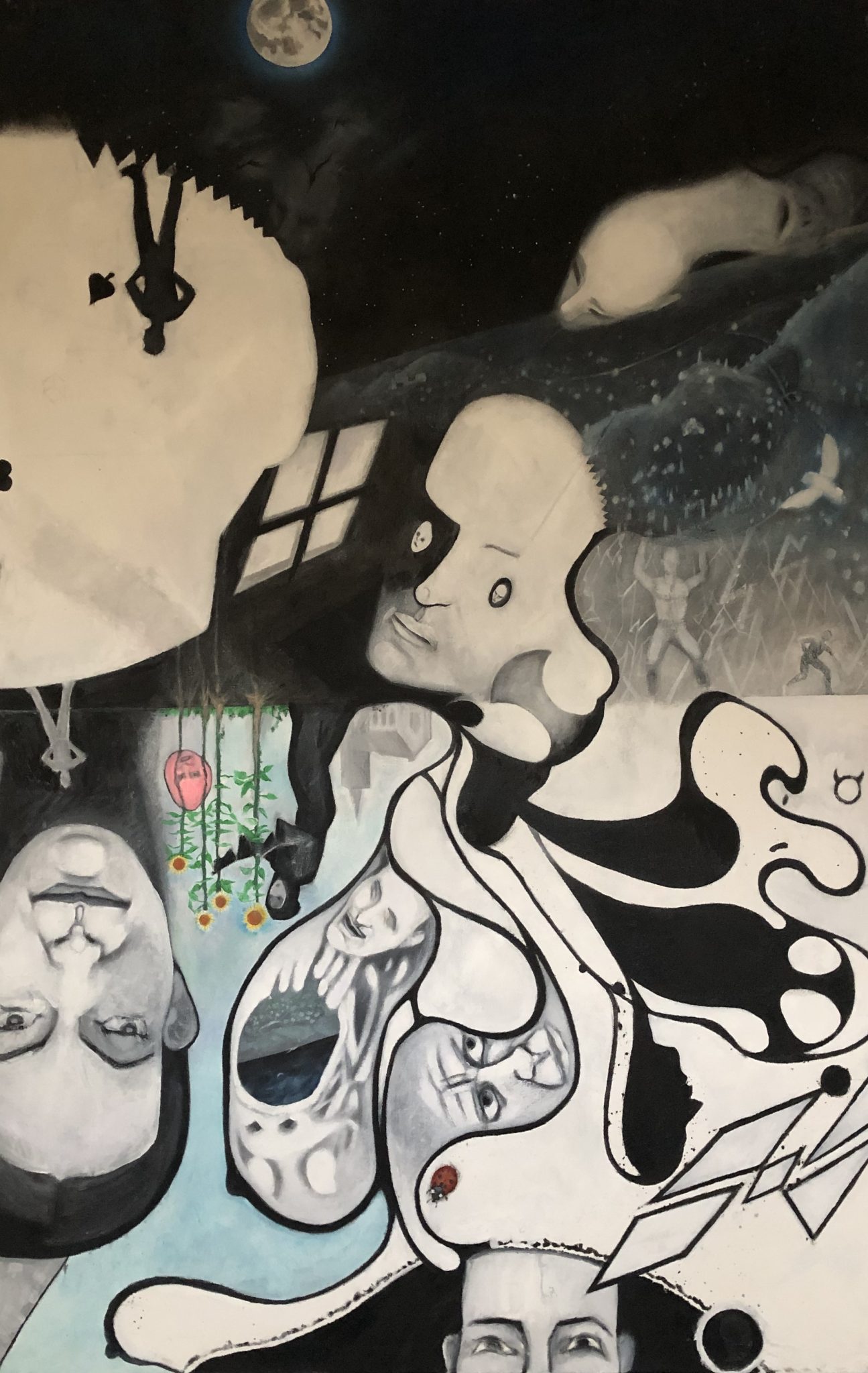
Traumwelt. (120)
This image is my second semi-abstract and is an adjustable image which can be beheld either way up ( ) and features, again, the pictures within pictures theme whose particular themes are self-evident. The picture is only pseudomonochromoid, and is quartered diagonally with some colourative additives. The ladybird belies the fiction of the picture plane, while the abstract flourishes are remotely redolent of Beardsley, who was an early childish beeinfluss and genius.
4X 39x31 oil on canvas
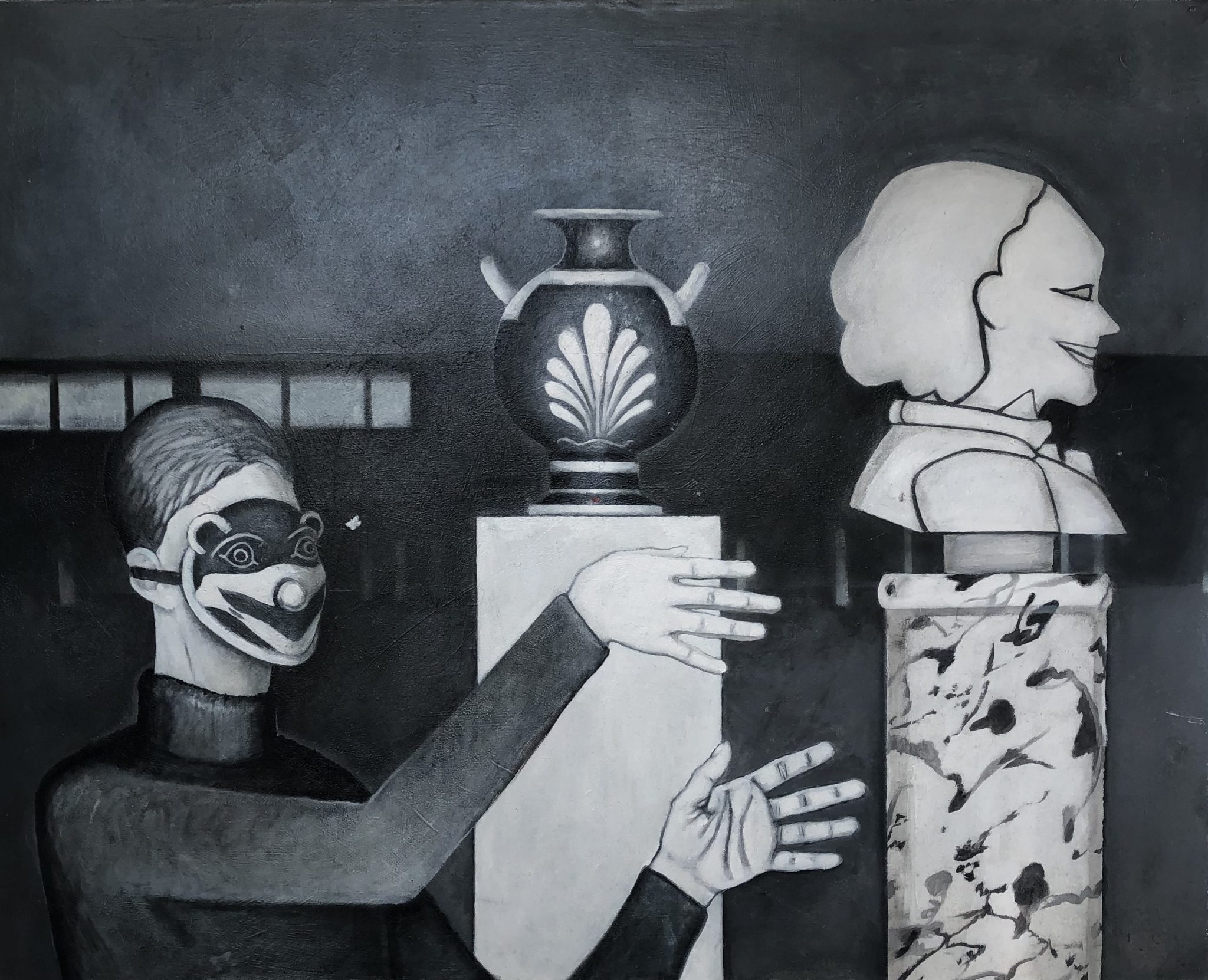
Antiquarian.(117)
A monochrome cartoon whimsy featuring a character wearing an ancient Greek animal mask, (originally the boss of a shield), stealing a vase in a spooky museum of ghostly voyeurs.
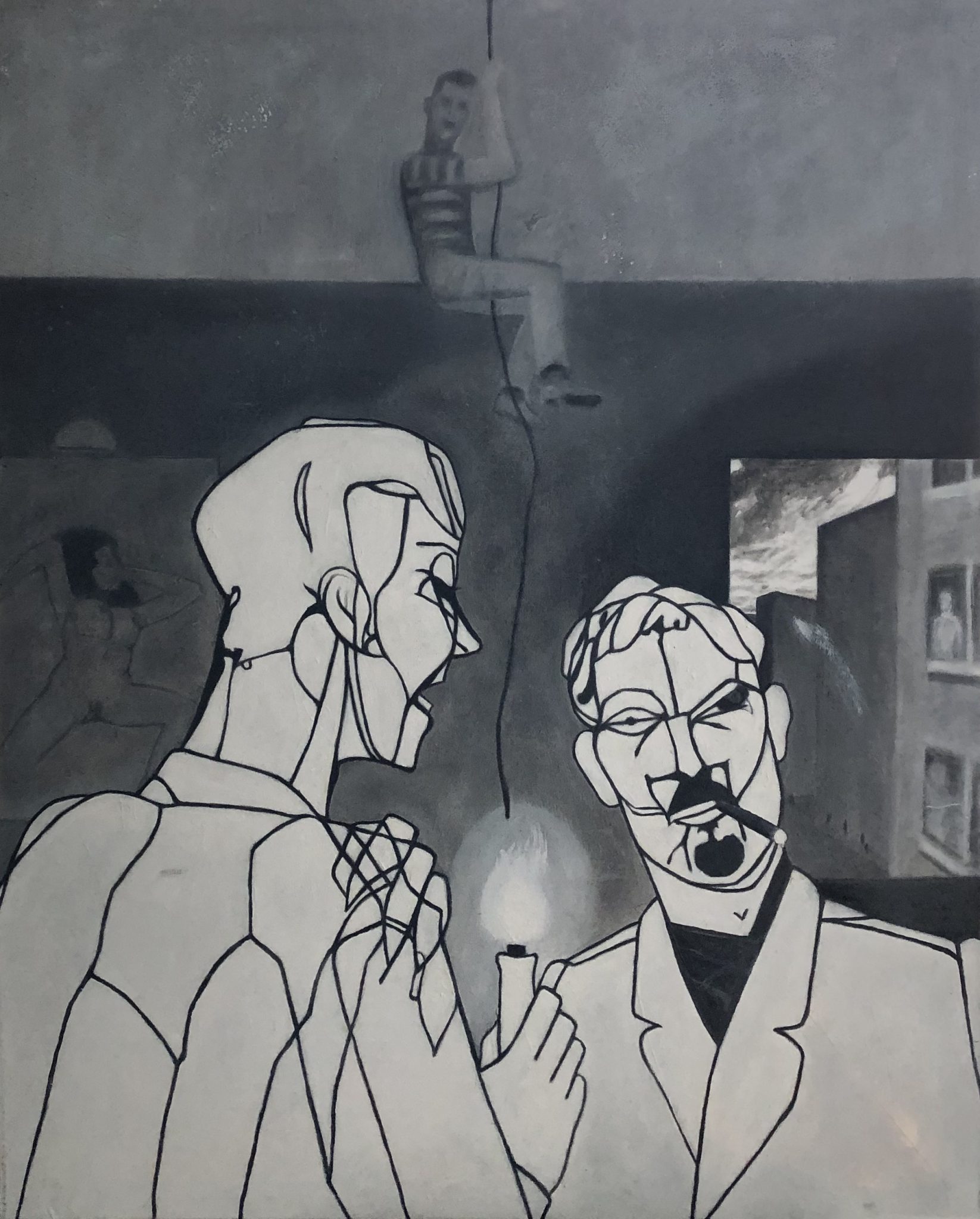
Burglar.(118)
Second monochrome cartoon whimsy featuring a burglat abseiling down into an office, while two shrewd executives discuss their next swindles.
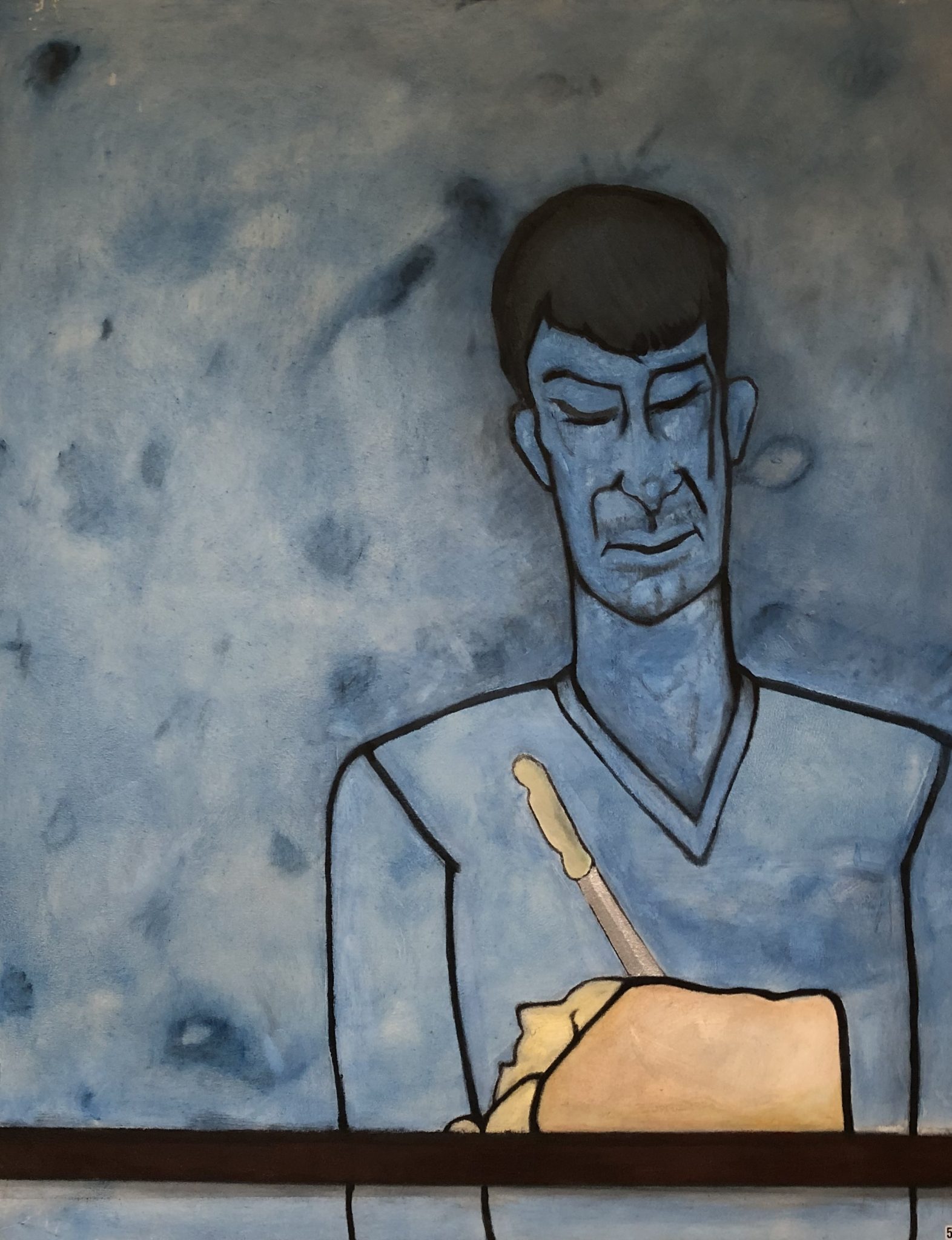
The misers aura. (121)
A cartoon whimsy in which blueness predominates and the suggestion of an aura haunts either a poet or a miser. The bread embodies the pareidolia of a wan face.
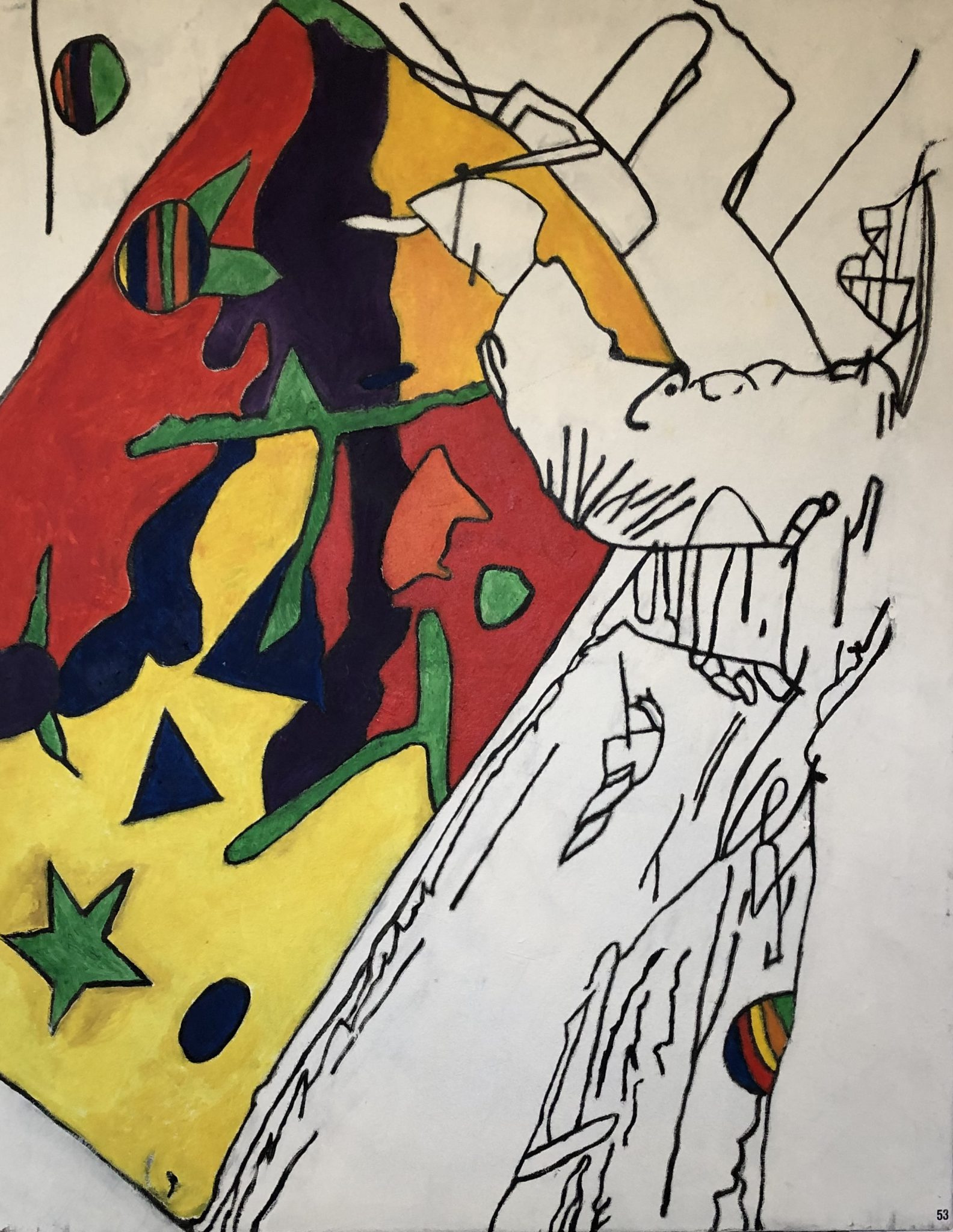
Fear of abstract art (122)
A Cartoon whimsy that mocks abstract art by embodying it. Or an opportunist ecotautology.